


|
Course type |
Typical format |
Skills gained |
Level |
Best for |
|
CE and certification |
Short course or course series |
Clinical knowledge and a record of study or testing |
Basic to mid-level |
Dentists with a clear study or CE goal |
|
Hands-on workshop |
Live demo and guided practice |
Models, bonding, wires, scans, IPR, or attachments |
Basic to mid-level |
Dentists who need practical skills |
|
Online and self-paced |
Videos, live webinars, or online case review |
Theory, diagnosis, digital steps, and plan review |
All levels |
Dentists who need flexible study |
|
Fellowship or advanced program |
Long course with tests and mentors |
Tooth movement, finishing, hard cases, and team care |
Advanced |
Skilled clinicians who want more depth |
|
Staff and practice training |
Team class, webinar, or office training |
Records, scan support, billing, schedules, and patient talks |
Role-based |
Assistants, coordinators, technicians, and teams |
September 18, 2026
What Every Dentist Should Learn from Orthodontic Courses in the Digital Era
CE, hands-on workshops, online courses, or fellowships—which orthodontic training path is right for you? This guide compares formats, skills gained, and costs to help you choose the program that fits your practice goals.

SoftSmile Team
Editorial Team

Orthodontic courses for dentists now teach far more than brackets and wires. Digital work has become a much larger part of training in 2026, and more adults than ever are asking about clear aligners — which means dentists need sound clinical judgment backed by strong planning skills. Courses range from a single weekend to several months, and while cost matters, it is not the deciding factor: what matters is whether the course prepares you for the cases you actually plan to treat. This guide explains what modern training should cover and how to compare your options.
Here's what this guide covers:
-
Why continuing education matters for modern practice.
-
Types of training — from hands-on to online.
-
The digital skills every dentist should learn.
-
How to choose the right course.
-
Common mistakes to avoid.
Why Continuing Education Matters for Modern Orthodontic Practice
The American Association of Orthodontists ran a patient survey in 2025 and found about 6.66 million active patients in member practices in the United States and Canada during 2024, with U.S. members treating about 1.91 million adults. The survey covers AAO members rather than the full market, but it still shows the scale of adult care. Adult patients may bring old dental work, gum concerns, or complex goals — all of which need review before treatment starts. Source: AAO.
Each appliance calls for its own skill set. Brackets require a working knowledge of wires, anchorage, and finishing; clear aligners demand the same care in diagnosis, along with attention to staging, attachments, IPR, and tracking. Orthodontic continuing education courses should link each tool to a clear diagnosis and a clear goal.
The World Federation of Orthodontists has updated its education guidelines. They stress evidence, current research, new tools, ethics, quality, and patient care. A short CE course is not equal to specialty study. Still, these points offer a useful test for any course. Source: WFO.
CE credits may satisfy a license rule, but the real clinical gain is better judgment. A trained dentist can explain the diagnosis in plain terms — along with its limits, the available choices, and the planned steps — and honest, clear facts tend to support case acceptance without false promises. A shared digital plan helps the whole care team, the lab, and the patient alike, which is why digital planning is now a core skill.
Types of Orthodontic Courses for Dentists

Programs differ in depth, support, and purpose. The best orthodontic courses for dentists fit both the learner’s current scope and the next clinical task ahead — a weekend class is simply not the same thing as a long CE track or a fellowship, and each option deserves a fair test.
Continuing Education (CE) Courses and Certification
Orthodontic continuing education courses are a common starting point. The group includes orthodontic CE courses for general dentists, offered by universities, dental groups, and training firms. Compare who awards the credits and whether your dental board accepts them. Some orthodontic certification courses include a test, while others only record attendance — and either way, a certificate neither replaces supervised work nor grants specialist status.
Hands-On and Clinical Workshops
Hands-on orthodontic courses turn theory into skill. Working with models, records, or guided tasks, they build the practical side of bonding and wire work as well as scans, attachments, IPR, and plan review. CARE Academy — a clinical education program developed by orthodontist Dr. Anas Athar — will combine monthly virtual study clubs with one-day intensive courses and advanced two-day programs, including practical aligner training. Contact CARE Academy to confirm the current format and agenda before enrolling. Straight-wire orthodontic courses follow the same cycle of learning, practice, and review.
Online and Self-Paced Courses (Including Free Options)
Online orthodontic training courses may use videos, live webinars, or virtual case review. They fit around patient care and let you repeat a lesson as often as needed, and free online orthodontic courses can be a good introduction to a topic — though they rarely prove hands-on skill. Whether you search for orthodontic courses near me or compare options in the USA, UK, India, or Australia, check access to faculty and your local CE rules; a live course should allow real case discussion.
Fellowship and Advanced Programs
Advanced orthodontic courses and fellowships suit dentists who already have case experience. They may cover tooth movement, finishing, impacted teeth, TADs, or team care. Look for case review that continues over time, a clear statement of how each learner is tested, and mentors who are easy to reach between sessions. These programs add depth, but they do not replace specialty study.
Staff, Billing and Practice Management Training
Orthodontic courses for dental assistants and hygienists may cover records, photos, scans, attachments, and patient guidance, while dental technician courses focus on models, appliances, and quality checks. Orthodontic billing courses teach coding and records, and practice courses may extend to schedules and fees. Team training improves daily work — but the doctor must still diagnose, prescribe, and approve care.
8 Orthodontic Learning Options to Compare
The list below is in alphabetical order, not a ranking. The options differ in scope, format, focus, and time, so the right choice depends on your experience and your role in patient care.
|
Course or program |
Format |
Main clinical focus |
Best suited to |
|
Two-day live workshop with follow-up |
Case choice, aligner mechanics, digital plans, and in-house production |
General dentists who plan to add clear aligners | |
|
American Orthodontic Society — Comprehensive Straight Wire Orthodontics |
Live course series; online version also offered |
Diagnosis, tooth movement, and full treatment with fixed braces |
Dentists who want a long and structured course |
|
CARE Academy — Aligner Intensives and Peer-to-Peer Case Review |
Webinar or live courses |
Digital plans, aligner mechanics, case review, and problem solving |
General dentists who want practical aligner case talks |
|
Dawson Academy — Clear Aligner Therapy for Complete Dentistry |
Two-day live course with hands-on work |
Aligners used with restorative, bite, and team care |
Dentists who add tooth movement to full care plans |
|
Decisions in Dentistry — A Comprehensive Review of Clear Aligner Therapy |
Online course for self-study |
Evidence, results, limits, and clinical use of aligners |
Dentists who want a short review or update |
|
Eight-day live intensive |
Diagnosis, growth, cephalometrics, fixed braces, and model work |
Dentists who want a focused hands-on course | |
|
Gerety Orthodontic Seminars — Comprehensive Orthodontic Education |
Online study with mailed tools and model projects |
Full non-extraction treatment with straight-wire braces |
General dentists who want long remote study with graded tasks |
|
University of Florida — Orthodontics for the General Dentist or Pediatric Dentist |
Two-day live course with hands-on work |
Diagnosis, cephalometrics, plans, fixed braces, and aligners |
Dentists who want a university-led introduction |
Use this list to compare short workshops with comprehensive orthodontic courses. These orthodontic training courses vary widely in scope, so ask each provider for current course goals — and about faculty access, tests, case rules, support, and course records.
Digital Orthodontics — The Skill Set Every Dentist Should Build

Digital tools are now part of routine orthodontic care. A general dentist who offers aligners must check scan quality, review the treatment plan, and explain to the patient that a digital simulation is not a guaranteed clinical result. The WFO guidelines list diagnosis, treatment planning, biomechanics, and 3D diagnosis as core topics. A CE course is not a substitute for specialty training, but these topics offer a useful framework for judging a digital course. Software such as VISION can display each planning step while the doctor keeps clinical control; for more context, see the WFO guidelines and SoftSmile’s overview of orthodontic software. See the software overview.
A course that omits digital skills leaves a key part of the workflow unexplored. At a minimum, it should cover:
- Intraoral scanner use, digital impressions, and STL file quality.
- CBCT integration when clinically indicated.
- 3D treatment planning and case simulation.
- Staging and segmentation of the digital model.
- Attachments and IPR (interproximal reduction) planning.
- Clear aligner treatment planning and digital smile design.
These skills form one continuous process: a good scan must yield a clean digital model, final tooth positions must match the diagnosis, and each stage must use movement that is likely to work. Good case-based learning uses a real case and asks the dentist to review each step, not just learn the terms.
“Doctors should not review an aligner setup by looking only at the final result. They need to examine the sequence: when space is created, which teeth move first, how anchorage is maintained, and where attachments or IPR support the planned movement. Most planning errors become easier to see when the stages are reviewed one by one.”

Clear Aligner Treatment Planning
Clear aligner courses start with a digital scan and should teach case choice, staging, and smile design. Learners should see how each stage becomes a set of trays — that is what lets the dentist test the plan against the diagnosis rather than approve it on faith. Software can suggest a sequence; the doctor decides whether it fits the patient.
3D Treatment Planning and Case Simulation
3D planning software builds a model from a scan, splits the teeth, and shows movement in stages. The dentist must check roots, arch form, contacts, anchorage, and movement limits, so a useful course lets learners both explain the sequence and edit it.
VISION can prepare a first setup and staging plan, and the setup stays open to edits — which teaches a key point: preparation is not approval. Software may suggest a sequence, but the doctor remains in charge of diagnosis and care. SoftSmile explains this line in its overview of AI-assisted dental workflows. Read the AI workflow overview.
Once you know the course types, compare their value: a useful course should offer more than a lecture.
How to Choose Among the Best Orthodontic Courses for Dentists
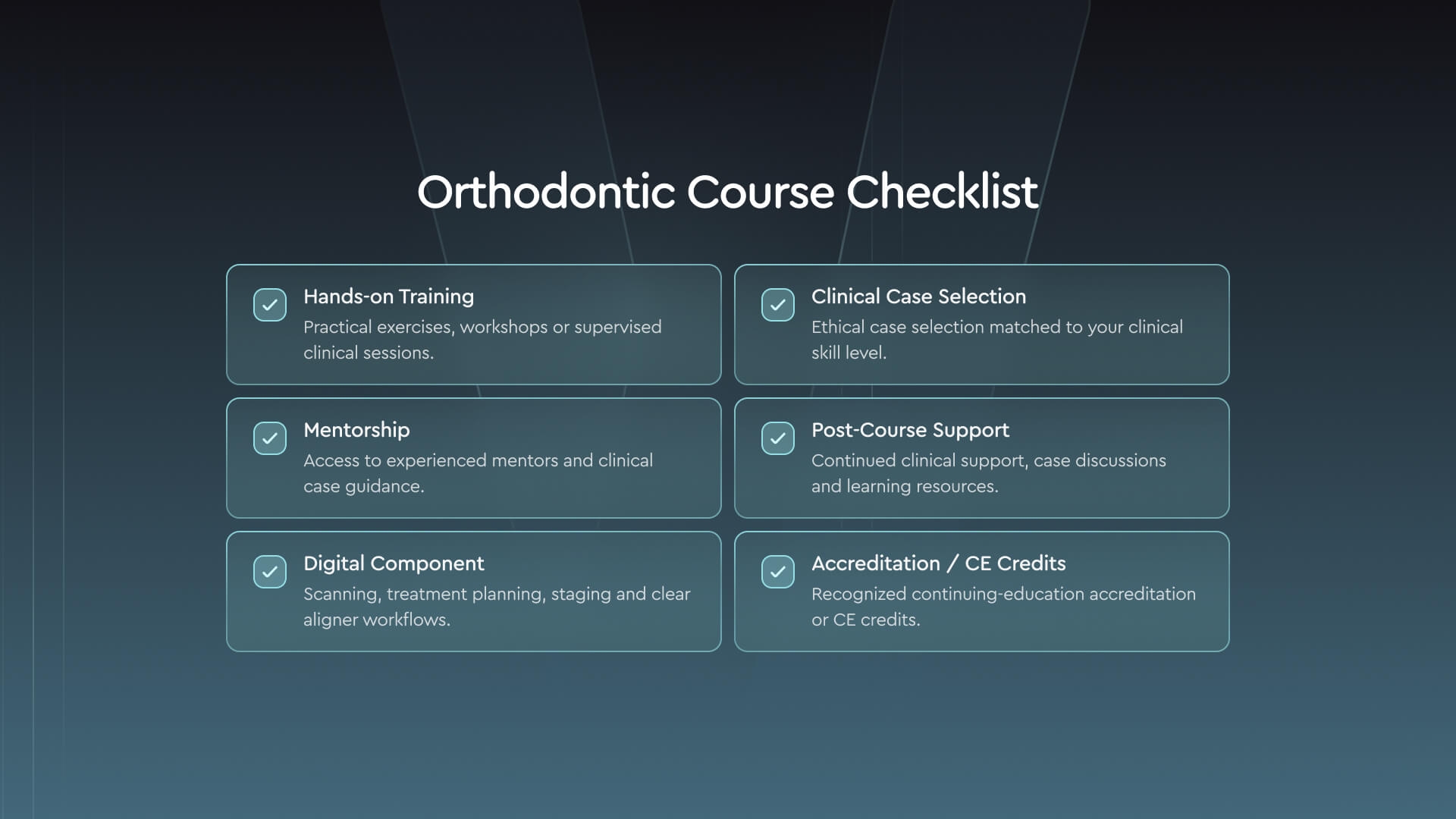
Many course pages sound alike, so look at the details to find real value. Start with the full course plan and check what each lesson will teach, how much time is set aside for case review, and whether you will edit a plan yourself or just watch a demo. Ask who gives feedback, how fast they reply, and whether the same teacher stays with the group. A clear course page states the skill level and lists tools, tasks, tests, and support — compare those facts with the cases you actually see at work. Do not pay for broad claims; pay for skills you can name and test. Good orthodontic courses set clear limits: they state what the course can teach and what still needs a mentor, which makes it easier to plan safe first cases and judge the next stage of study.
• Hands-on time - when you compare hands-on orthodontic courses, ask how much of it is guided clinical work. Two hours on a model does not make a course complete.
• Mentorship - ask who can review a question or a case after the course ends. Good feedback may matter more than the number of CE credits.
• Digital work - look for scans, 3D planning, and aligner plan review; a course on fixed braces alone does not teach the full digital process.
• Safe case choice - the course should teach when to refer, because severe jaw problems and surgical cases need specialist care.
• Support after class - check for case calls, faculty access, or an alumni group.
• CE approval - ask whether your dental board accepts the credits, which is vital when the provider is in another area.
Match the course to your starting point. A general dentist may need basic diagnosis and model work, along with simple case choice and clear referral rules, while a skilled orthodontist may want a deeper course on staging, tooth movement, or finishing. For digital training, ask whether learners edit a staged case in VISION or another tool, and apply one simple test: can the doctor inspect and change the plan before production? Strong courses combine tests, mentors, and real digital work. Explore VISION.
Common Mistakes Dentists Make When Learning Orthodontics
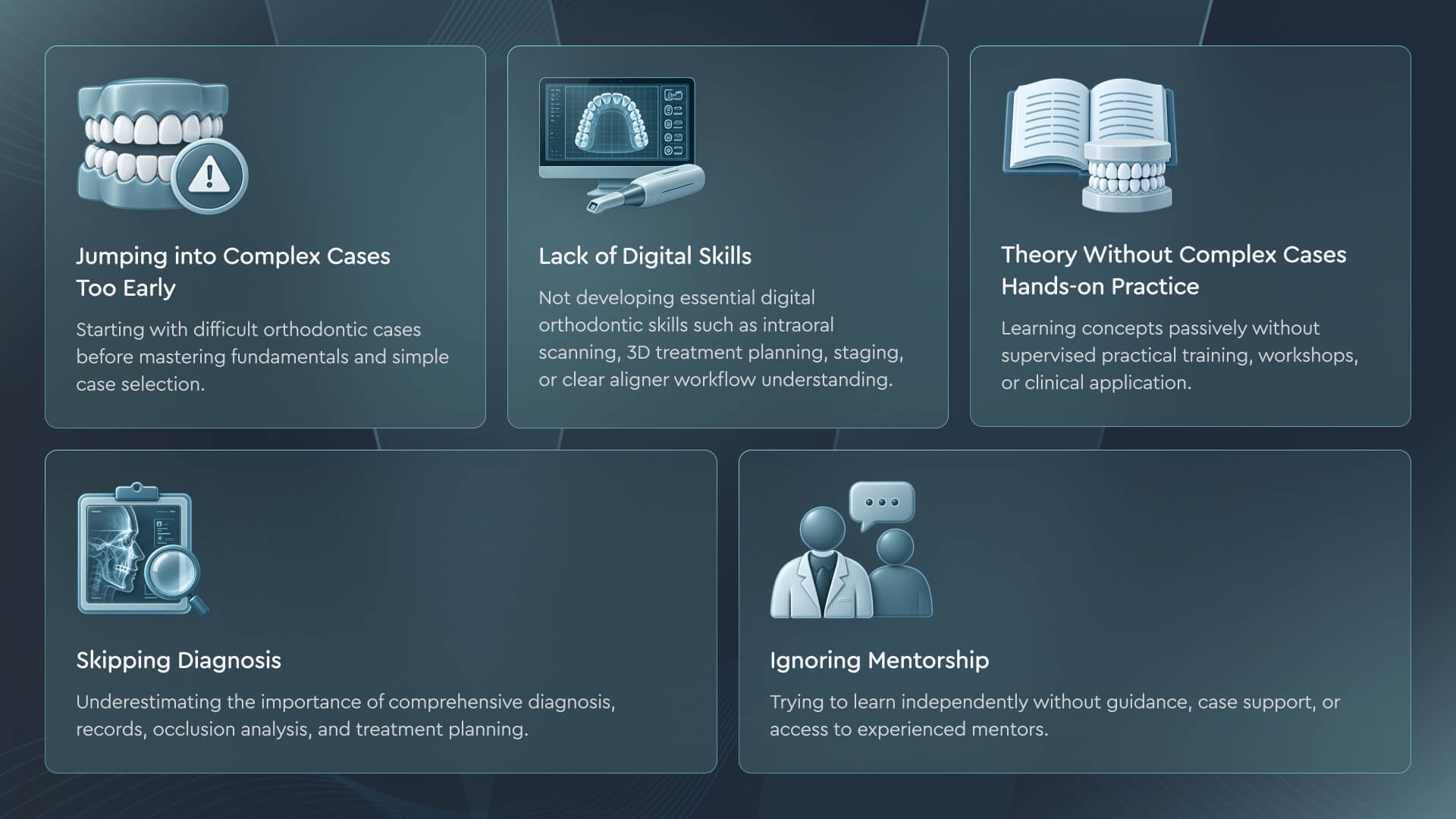
A new skill is exciting, but safe progress takes time. The mistakes below are common when dentists start orthodontic training.
• Starting with a hard case - mild crowding or simple spacing may make a sound first case; impacted canines and severe jaw problems do not, and a two-day course does not change that risk.
• Skipping diagnosis and face review - a weak first plan usually needs changes during care, while a full diagnosis at the start saves time later.
• Using videos alone - wire work and bracket placement are motor skills, and watching is not the same as guided practice.
• Treating children without the right course - children need care that reflects growth and development, which adult courses may not cover. That gap can cause errors.
• Skipping digital review - a neat staged plan still needs a check against the full records: gum health, roots, and treatment goals. The case may use VISION or another tool; in every case, approval is a clinical choice. Explore VISION.
Most of these errors share the same fix: start with simple cases, plan each step before you place a bracket, and keep a mentor close for your first cases.
About SoftSmile — Digital Treatment Planning for Modern Practice
SoftSmile makes VISION, a digital tool for clear aligner planning. It prepares scans, segments the teeth, and supports setup, staging, contact checks, attachments, review, and export — with every plan open for the doctor to review and edit before approval. Explore VISION.
SoftSmile says its AI-based process can make planning up to 95% faster than manual work; that figure is the company’s own product claim, not an independent test.
Automation can cut repetitive setup work, but it cannot replace skill in diagnosis, tooth movement, case choice, consent, or follow-up. A useful course teaches doctors to question each setup and to record the key edits they make.
A VISION demo shows each step, from the first scan to a plan the doctor can edit and approve. View the VISION demo.
Conclusion
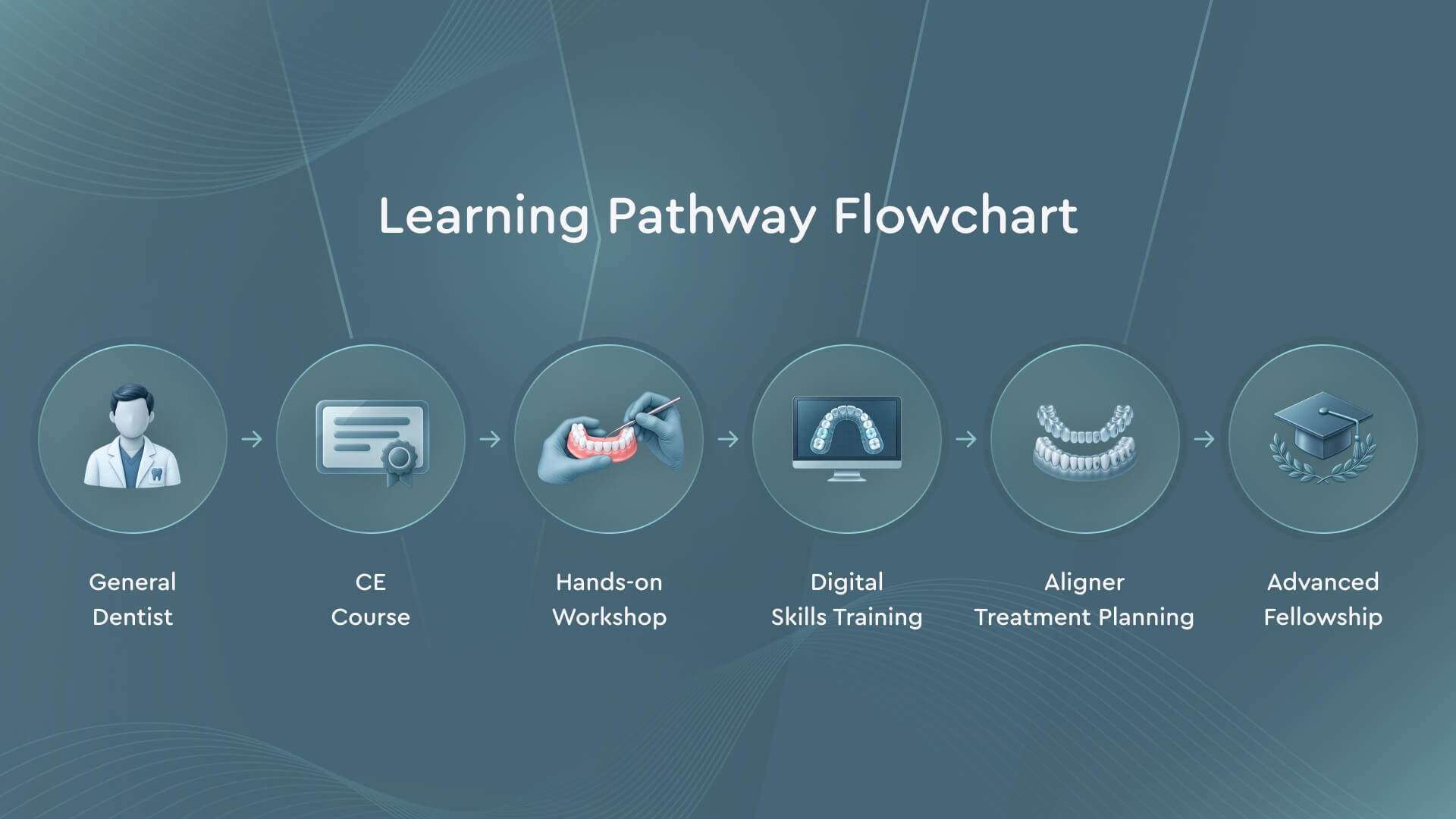
Orthodontic courses for dentists in 2026 should link clinical study with hands-on work and digital review. Every dentist must make a sound diagnosis, explain its limits, and stay within scope — and every digital case needs review before approval. Hands-on sessions build the motor skills; digital study makes planned tooth movement easier to check.
Choose course content, not just a format. Look for mentors, guided cases, and staged plan review, and apply one simple test: would you trust the review process for your own patient?
FAQ
Are online orthodontic courses as good as hands-on ones?
Online courses can teach diagnosis, theory, and digital steps, but they rarely replace guided practice for bonding or wire work. Online study works best when a teacher reviews your work.
Do general dentists need CE credits for orthodontics?
Rules depend on the region and the dental license. A course may count toward license renewal, but it does not automatically expand legal scope or grant specialist status — check the provider, the course topic, and the required records with your dental board.
What digital skills should I learn first?
Start with scans and staged plan review: learn to check the digital model, each stage, and the case preview, then move on to skills such as digital smile design. These basics help with both aligners and fixed braces.
Are there free orthodontic CE courses?
Yes. Dental groups, course firms, and product makers offer free webinars and short lessons, though schedules and credit rules can change, so check each session before you enroll. Free courses are useful for a first look; they do not prove hands-on skill.
How long does it take to start treating aligner cases?
There is no safe answer that fits every dentist. Readiness depends on past study and guided practice, along with local rules, mentor support, and case risk. A sound course should test skill and teach referral limits — not promise success after a set number of weeks.
What's the difference between a CE course and a fellowship?
A CE course teaches a defined skill in one or more sessions, while a fellowship takes longer, usually requires prior study, and adds mentor-led case review. Neither replaces specialty study.
Does an orthodontic course certificate make a dentist an orthodontist?
No. It shows that the dentist took a course or passed its test; specialist status requires approved postgraduate study and must meet local license rules.


Sign up for our newsletter!
Case Studies, Podcasts, Ebooks, Events, Webinars, Company news, and more...
By subscribing you agree to the Terms of Use and Privacy Policy.


