


|
Formula |
Numerator |
Denominator |
What it shows |
When it misleads |
|---|---|---|---|---|
|
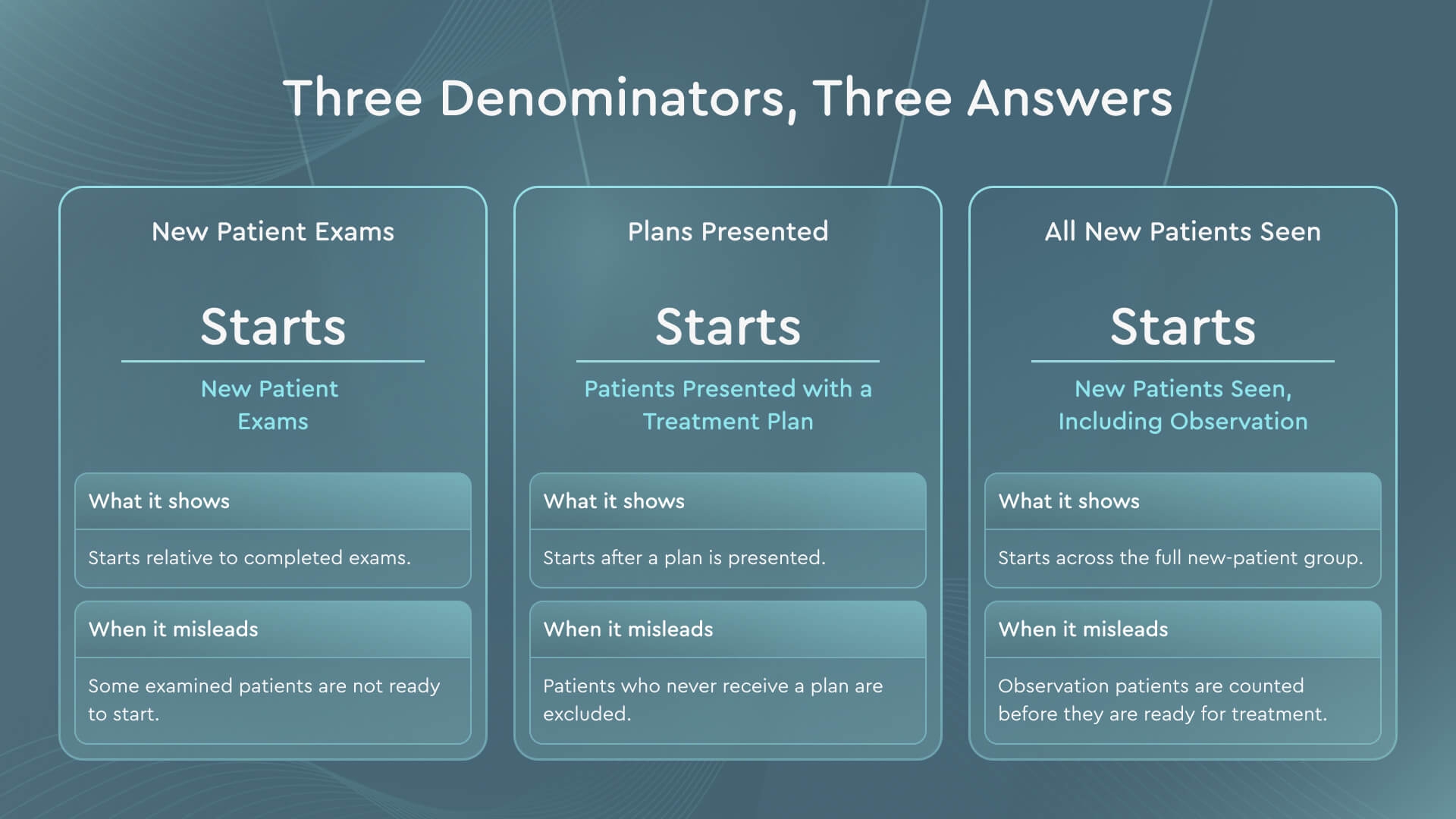
Starts ÷ new patient exams for active treatment |
Starts |
Exams logged as evaluations for active treatment |
Overall conversion of the exam schedule |
When observation checks or recalls are logged inconsistently |
|
Starts ÷ patients presented with a plan |
Starts |
Patients who received a full plan presentation |
The quality of the consultation itself |
When weak marketing stays hidden because only ready patients reach a presentation |
|
Starts ÷ all new patients seen, including observation |
Starts |
Every new patient seen, observation included |
The strictest view, comparable year over year |
When a practice with a large pediatric referral base looks weaker than it is |
Tech and Innovations
November 20, 2026
How to Increase Orthodontic Case Acceptance Without Pressuring a Single Patient
Orthodontic case acceptance is easy to discuss and hard to measure, because one practice can report three different rates from the same quarter. This guide explains how to calculate the rate with a fixed denominator, where consultations break down, and nine strategies that follow the patient’s path from first contact to follow-up. The goal is clearer communication and better decisions — not pressure on patients or the team.

SoftSmile Team
Editorial Team

Orthodontic case acceptance is easy to discuss and surprisingly hard to measure, since one practice can report three different numbers from the same quarter. For U.S. practice owners, treatment coordinators, and DSO leaders, this guide covers:
-
what acceptance means in an orthodontic practice;
-
three ways to calculate the rate, and which one to report;
-
where consultations break down, step by step;
-
nine strategies, in the order the patient meets them;
-
the metrics worth reviewing every month.
What case acceptance actually means in an orthodontic practice
In general dentistry, a case is usually considered accepted once the patient agrees to the recommended procedure. In orthodontics, practices may find it more useful to measure case acceptance by actual treatment starts after a new patient exam or initial consultation rather than by verbal agreement alone. A signed contract or down payment can indicate that a patient has accepted the proposed plan, but these events should be tracked separately if treatment has not yet begun, since the moment a patient says yes and the moment treatment begins can be weeks or even months apart.
Across general and specialty dental practices the gap is visible too, although the two figures measure different events: Planet DDS’s 2025 Dental Industry Outlook (March 2025) reports a 57% average case acceptance rate across more than 3,400 practices, counting treatment marked as accepted, scheduled, or completed, while the average completion rate for treatment planned in the first half of 2024 was 42% by year-end.
The gap exists because orthodontic decisions follow a different pattern: a teenage patient’s decision usually involves at least one parent, while an adult patient may need to align it with a spouse, a budget cycle, or planned restorative work. Some patients are placed in observation rather than active treatment. The American Association of Orthodontists (AAO) recommends a first orthodontic check-up no later than age 7, and some developing conditions may be monitored before treatment is indicated. Practices should distinguish these patients from those who decline a recommended plan.
Seen this way, case acceptance in orthodontics describes the state of a process at every stage, from the first call to the first appliance, rather than the skill of one person in the consultation room.
How to calculate your orthodontic case acceptance rate: three denominators, three answers
Both the definition of a treatment start and the denominator affect the rate. These are practical reporting options, not standardized industry definitions. For each formula, count starts only among patients included in its denominator and use the same follow-up window.
Illustrative calculation, not industry data: a practice sees 140 new patients in a quarter, including 30 who are placed in observation, and separately tracks 110 patients evaluated for active treatment, 80 of whom receive a full plan presentation, with 56 of those patients starting treatment within the defined follow-up window. The same quarter produces 51% by the first formula, 70% by the second, and 40% by the third, so a number quoted without its denominator says little on its own.
Deferred starts add another distortion, since a patient who agrees in March and starts in June lifts June’s figure while March looks weaker than it was. A steadier approach is to track each month’s exams as a cohort over an observation window the practice sets in advance, such as 90 days (a practice choice rather than an industry standard), so that a June start from the March cohort counts toward March if it falls within that window.
As a final check, whichever formula you choose should be written into the practice SOP and kept unchanged, since once the definition shifts, the trend line becomes hard to read.
What counts as a good rate — and why benchmarks mislead
In the 2025 Dental Industry Outlook, data from more than 1,500 practices using Cloud 9 orthodontic software show an average of 315.8 new patient exams, 203.5 starts, and a 64.4% average acceptance rate per practice in 2024. These figures produce a starts-to-exams ratio of approximately 64.4%, although comparisons still depend on how each practice defines and records these events.
The most reliable comparison is usually your own acceptance rate over the previous four quarters, calculated with the same formula each time, so that a change in the number reflects a change in the process.
Where orthodontic consults actually break down
Most practices look for the problem in the consultation room, but orthodontic case acceptance can be lost at any of five stages, several of which happen before the treating doctor and the patient meet. Cost is one consideration. According to the ADA Health Policy Institute report National Trends in Dental Care Use, Dental Insurance Coverage, and Cost Barriers (September 2026), 12.9% of the U.S. population reported not receiving needed dental care because of cost in 2025, rising to 17.0% among working-age adults (ages 19–64). By comparison, 5.0% reported cost-related barriers to needed medical care (7.4% among working-age adults). These figures describe dental care broadly, not orthodontic case acceptance specifically. In orthodontics, the cost discussion may also reveal questions about the proposed treatment plan.
The first phone call
A patient who submits an online request and hears back two days later may already have booked elsewhere. A team member can explain the first visit and offer an appropriate fee range rather than an unclear response. Response time deserves the same attention as any of the ways to promote an orthodontic practice.
Records and the exam
When digital records are scattered, with the intraoral scanner’s output in one system, the radiographs in another, and the photographs on an assistant’s phone, the treating doctor may spend part of the visit assembling the case instead of discussing it. In VISION, imported scans, CBCT data, and clinical photographs sit in the same case, so the treating doctor can review the plan before the patient sits down.
The plan presentation
A treating doctor who explains malocclusion every day can forget how abstract a Class II relationship or a 4 mm arch-length deficiency sounds to a patient, a gap often called the curse of knowledge. A patient who nods through an explanation of the diagnosis and recommended treatment may agree in the room yet struggle to explain the reasoning at home.
The fee conversation
In many practices, the treating doctor presents the plan and leaves, and a coordinator discusses fees later. Whatever the format, each handoff can reset the conversation, so a patient who hears the number later may be weighing a price rather than a plan.
The follow-up that never happens
Finally, “I’d like to think about it” is often noted in the chart and then left alone. Without a reason written down, a date, and a person responsible, the patient may drift, and the practice has little to go on later in judging whether the pause was about money, timing, or genuine doubt.

Why orthodontic patients say “I’ll think about it”
Decisions vary from patient to patient: for a teenage patient, a parent is usually involved and weighs the clinical advice alongside the patient’s own concerns, while an adult patient typically decides personally and may be motivated by function, esthetics, or planned restorative work. From an adult patient, “I’ll think about it” can mean “I need to explain this to my spouse,” and the patient leaves with nothing to support that explanation.
Second opinions add another layer, since some patients now compare a specialist’s plan with a direct-to-consumer aligner offer, often without a reliable way to judge the clinical difference. Case acceptance in orthodontics can stall here, sometimes less because the consultation went badly than because the patient walked out with nothing to show at home: no images, no staged plan.
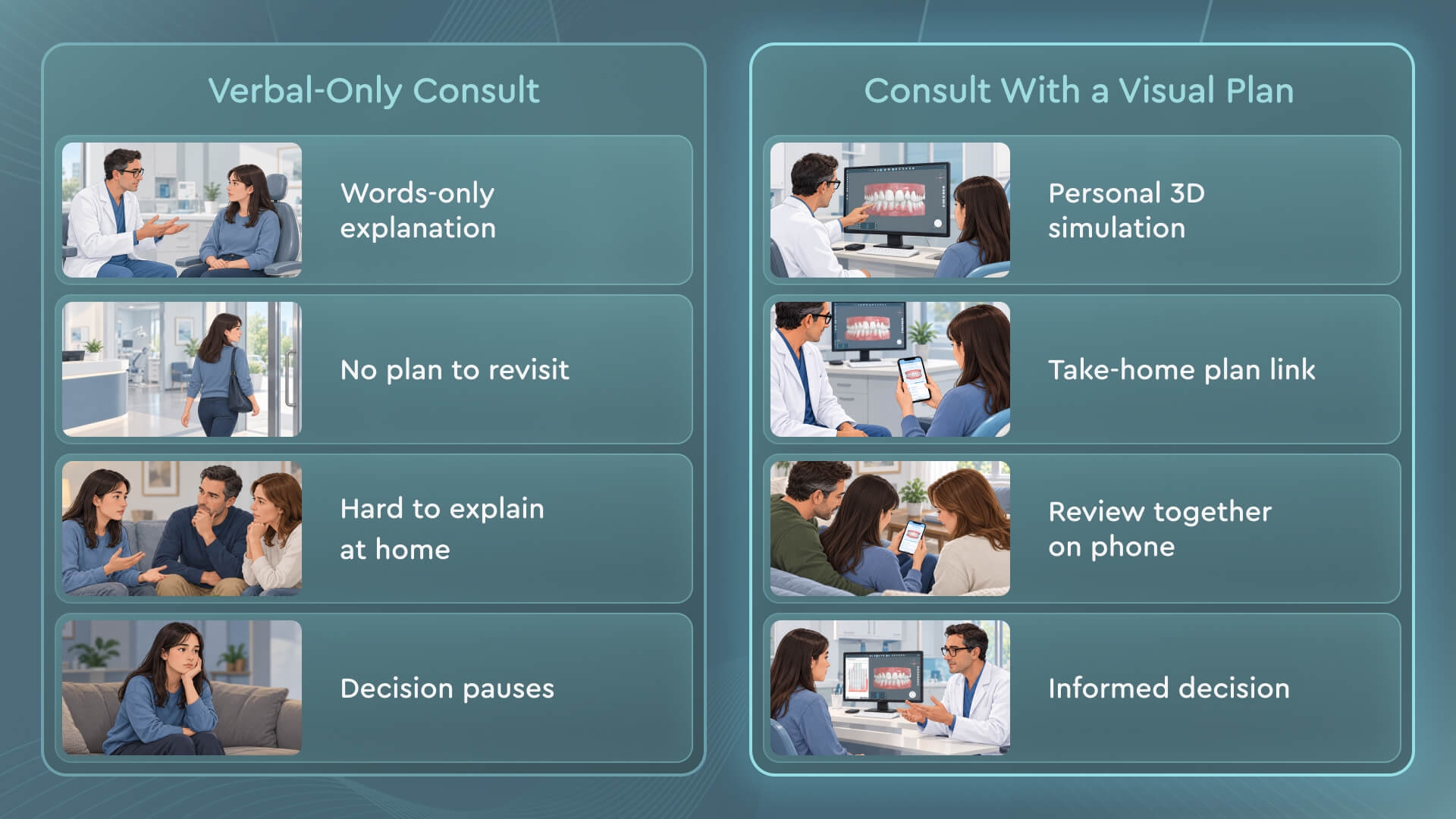
The strategies below follow the order in which a patient meets the practice rather than any ranking of importance. This sequence helps teams review the patient experience from first contact onward.
Nine orthodontic case acceptance strategies, in the order the patient meets them
-
Reply to every online request the same business day, from a named person. Identify the team member responsible for the reply rather than relying solely on an automated confirmation.
-
Prepare appropriate records ahead of the treatment discussion when the clinical workflow allows. The treating doctor determines which scans, photographs, history, and radiographs are needed and when to obtain them. Reviewing available records beforehand can leave more time to discuss the proposed plan.
-
Ask what brought the patient in now. Writing the answer into the chart gives the treating doctor and the coordinator a shared reference point.
-
Show the starting situation through the patient’s eyes. Photographs and a 3D model of the patient’s own teeth make crowding or a deep bite visible in a way a verbal description alone often cannot.
-
Visualize the planned movements and stages, not just the end point. Presenting the simulation as a plan rather than a promise helps keep the conversation clinically honest, bearing in mind that the treating doctor remains responsible for reviewing and approving the plan before it is presented.
-
Offer clinically acceptable alternatives alongside a clear recommendation. When clinically appropriate, options may include clear aligners or fixed appliances, comprehensive or limited treatment, or treatment now versus observation. The treating doctor should explain which options are suitable for the individual diagnosis and treatment objectives. For an adult patient with a fixed budget, however, three equal choices can turn a decision into a comparison project, so one recommendation with the alternatives as context often works better.
-
Discuss the fee in the same room, right after the plan, with the numbers on screen. Keep the treatment coordinator and treating doctor available to answer financial and clinical questions.
-
Send the patient home with a link to the plan that opens on a phone. The link lets the patient show the same images and stages to a spouse or parent.
-
Put every undecided patient into a pending system that records who follows up, when, and with what. A follow-up that answers the patient’s actual question is usually more useful than a generic reminder.

What a treatment simulation changes in the consult room
A patient is being asked to commit to something they cannot picture, and a simulation turns that abstraction into an object the treating doctor and the patient can look at together. A concise presentation can show the initial position, planned movements, and anticipated changes. Treatment-time estimates, when available, should be discussed as estimates rather than promises. Technical staging details can be explained as needed, based on the patient’s questions.
The treating doctor should explain that a simulation illustrates planned movements, not a guaranteed outcome. Assessing whether those movements are clinically appropriate and achievable remains the treating doctor’s responsibility. In other words, the software proposes; the treating doctor decides.
Timing matters: a simulation must be available when the treatment discussion takes place. In VISION, automated segmentation and staging help the treating doctor prepare a simulation before the visit, within software that holds FDA 510(k) clearance (K212770), and our overview of orthodontic software gives a wider view.

The fee conversation: where clinical trust meets a number
Ideally, the patient first hears the fee in the consultation room rather than at the front desk, so before the consultation the team should agree on:
-
who states the fee: the treating doctor, the treatment coordinator, or both in sequence;
-
which financing options are offered, including the down payment;
-
what insurance verification has confirmed and what is still an estimate;
-
when the patient will receive a written summary of the fee, the expected changes, and the patient’s responsibilities.
Present the total fee and available payment options clearly, without assuming which format a patient prefers. Where insurance is involved, the same honesty applies: the practice can usually confirm eligibility and orthodontic benefits in advance, but the final reimbursement remains an estimate.
The pending list: the system most practices never build
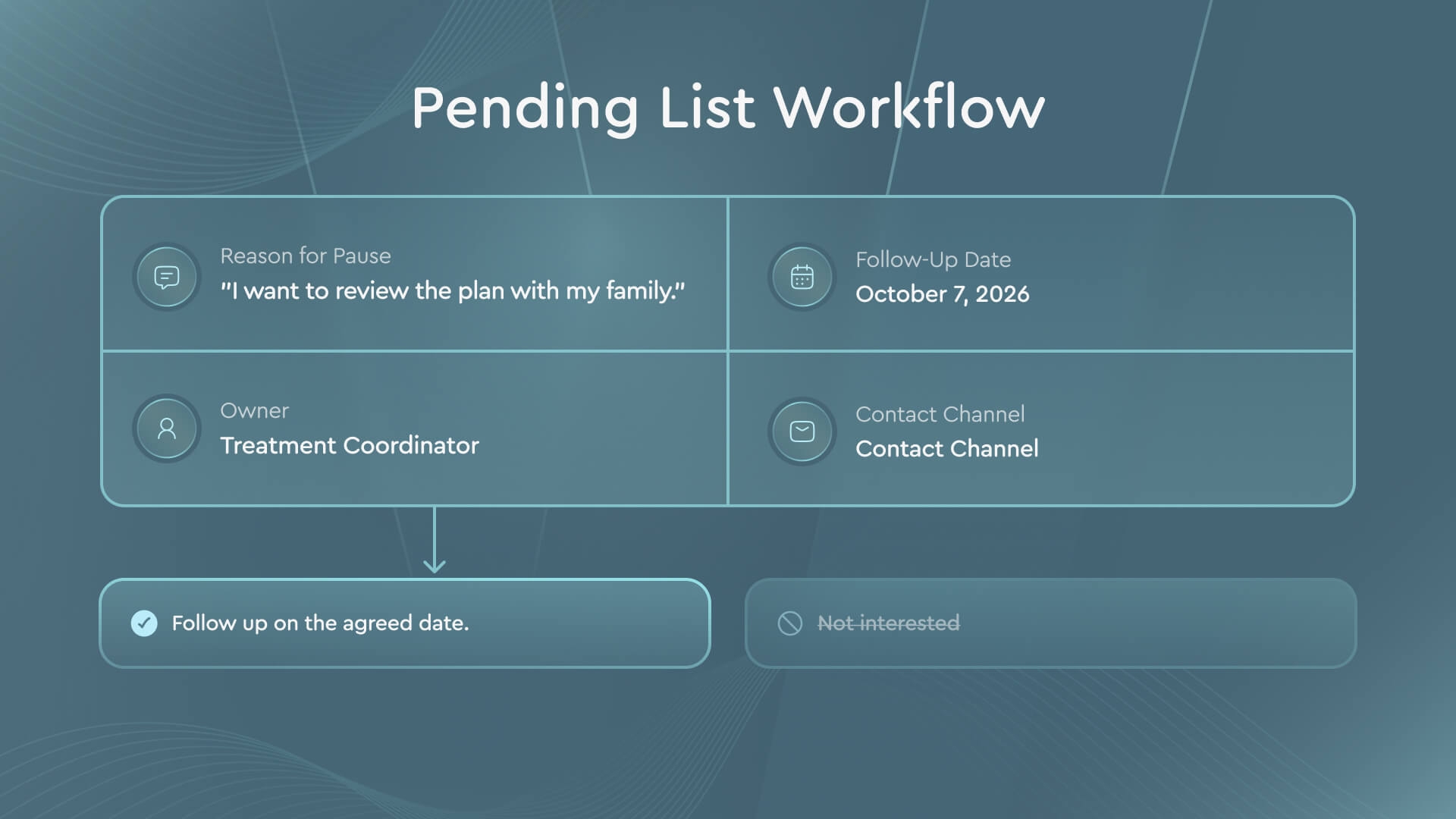
A pending list is useful only when the team has a consistent follow-up process. For each undecided patient, the record should capture the reason for the pause in the patient’s own words, the date of the next contact, the person responsible, and the preferred channel.
For example, a patient may leave the consultation because a spouse needs to review the proposed treatment and fee. Rather than recording the case as “not interested,” the coordinator documents the concern, shares the treatment plan through an approved channel, and schedules a follow-up, so that the next contact can resolve remaining questions without treating the delay as a rejection.
The SoftSmile Portal brings patient case information, treatment plans, and clinical documents into one cloud-based workspace. Role-based permissions help team members access information relevant to their responsibilities, supporting coordination between the treating doctor and the treatment coordinator.
What to track every month — and what to ignore
|
Metric |
How it is calculated |
How often |
Decision it informs |
|---|---|---|---|
|
Acceptance rate |
Starts ÷ the denominator fixed in your SOP |
Monthly |
Whether process changes are working |
|
Same-day start share |
Starts on the day of the consultation ÷ all starts |
Monthly |
Whether an immediate start is possible |
|
Average time from exam to start |
Days between exam and start, averaged across starts |
Monthly |
Where decisions or scheduling stall |
|
Pending patients who start within 90 days |
Pending patients who start within 90 days ÷ all new pending patients in the same cohort |
Quarterly |
Whether follow-up leads to treatment starts |
|
Consultations with visualization |
Consultations where the patient saw a 3D plan ÷ all consultations |
Monthly |
Whether the planning workflow keeps pace with the schedule |
Review these figures alongside no-show rates and other practice management data. Your orthodontic case acceptance rate belongs to the practice as a whole, since it reflects scheduling, records, the presentation, and follow-up together.
Avoid individual coordinator “closing percentage” targets: they may encourage pressure rather than patient understanding.

Five habits that quietly lower acceptance
Some habits that lower acceptance are small enough to go unnoticed. Apologizing for the fee before the value of treatment has been explained can signal that the number itself is a problem, and discussing the plan with an assistant in professional shorthand can turn the patient into a spectator. Promising a treatment time without a range can set up a broken expectation if refinements are needed later.
Repeatedly rebuilding a plan can complicate the consultation workflow, while reviewing and revising an existing version may help the team keep the discussion organized. Our overview of AI tools in dentistry discusses digital tools for treatment planning. Finally, a consultation in which the patient is never asked a single question can leave the team guessing about what genuinely matters to them.
Where SoftSmile fits
A useful consultation starts with a treatment plan that the treating doctor can review and explain clearly. VISION treatment planning software supports digital setup and 3D treatment visualization, allowing the treating doctor to evaluate the proposed plan before discussing it with the patient.
The Portal keeps case information and treatment plans accessible to the clinical team, while WebViewer lets patients revisit a shared visualization after the consultation. These tools support a clearer discussion of the proposed treatment; the treating doctor remains responsible for clinical decisions and plan approval.
The purpose is to make the plan easier to review and discuss, not to promise a particular case acceptance rate.
FAQ
What is case acceptance in orthodontics?
It is the share of patients who start treatment after a new patient exam. A signed contract or down payment shows that the plan was accepted, but it is worth tracking separately until treatment actually begins, and some patients are legitimately placed in observation.
How do I calculate my orthodontic case acceptance rate?
Calculate starts within a defined patient cohort and follow-up window using one fixed denominator: new patient exams for active treatment, patients presented with a plan, or all new patients seen, including observation. Whichever formula is chosen should be recorded in the SOP and kept unchanged.
What is a good orthodontic case acceptance rate?
It depends on the denominator and the patient mix. The most reliable benchmark is usually your own rate over the previous four quarters, calculated the same way each time.
Who should present the fees — the treating doctor or the treatment coordinator?
Either can, as long as the role is agreed in advance and the fee is discussed in the same room, right after the plan. Questions about clinical necessity, however, should always go back to the treating doctor.
Do 3D treatment simulations really affect case acceptance?
We don’t claim that a simulation alone raises acceptance. What it does is give patients a visual reference for discussing planned movements and stages, and something to show at home.
Start with one number
Choose one formula, document it in your SOP, and calculate last quarter’s baseline. A clear, visual treatment plan is one of the few parts of the process that can be ready before the patient arrives, and to see how that looks in practice, book a VISION demo.


Sign up for our newsletter!
Case Studies, Podcasts, Ebooks, Events, Webinars, Company news, and more...
By subscribing you agree to the Terms of Use and Privacy Policy.


