
August 07, 2026
Understanding Orthodontic Appliances: Types and Clinical Applications + Checklist
From traditional metal braces to clear aligners and functional jaw-correcting devices—this guide covers every orthodontic appliance and its clinical application. Includes a practical checklist for quick reference.


SoftSmile Team
Editorial Team


Orthodontic appliances do more than straighten teeth. They correct bite problems, guide jaw growth, and protect long-term oral health. A well-chosen appliance changes how a patient chews, speaks, and cleans their teeth for the rest of their life.
This guide covers the full range of orthodontic appliances — fixed, removable, functional, and auxiliary — along with the clinical situations each one fits best. You'll also find a practical checklist at the end to keep on hand.
Clear aligners now sit among the most requested options in this list. Digital treatment planning has made them a precise, predictable choice for many cases, and platforms like SoftSmile VISION give clinicians the tools to plan and deliver aligner therapy with full clinical control.
What Are Orthodontic Appliances?

Orthodontic appliances are devices used to move teeth, correct bite problems, and guide jaw growth. Every design works on the same biological principle: steady, controlled force triggers bone remodeling, and the tooth moves into a new position over time.
Three broad categories cover almost every device in use today. Fixed appliances bond directly to the teeth and stay in place until a clinician removes them. Removable appliances come out for eating and cleaning. Functional appliances target the jaw itself, guiding its growth rather than just moving individual teeth.
Malocclusions show up in three directions, and appliances are built to address each one. Anterior-posterior problems involve how the upper and lower jaws align front to back. Vertical problems cover open bites and deep bites. Transverse problems involve arch width and crossbites.
Choosing the right device starts with identifying which of these directions needs correction — and how severe the case is.
Fixed Appliances
Fixed appliances stay bonded to the teeth for the length of treatment. They give the clinician constant control over tooth movement and work well for a wide range of malocclusions, from mild spacing to complex rotations.
Traditional Metal Braces
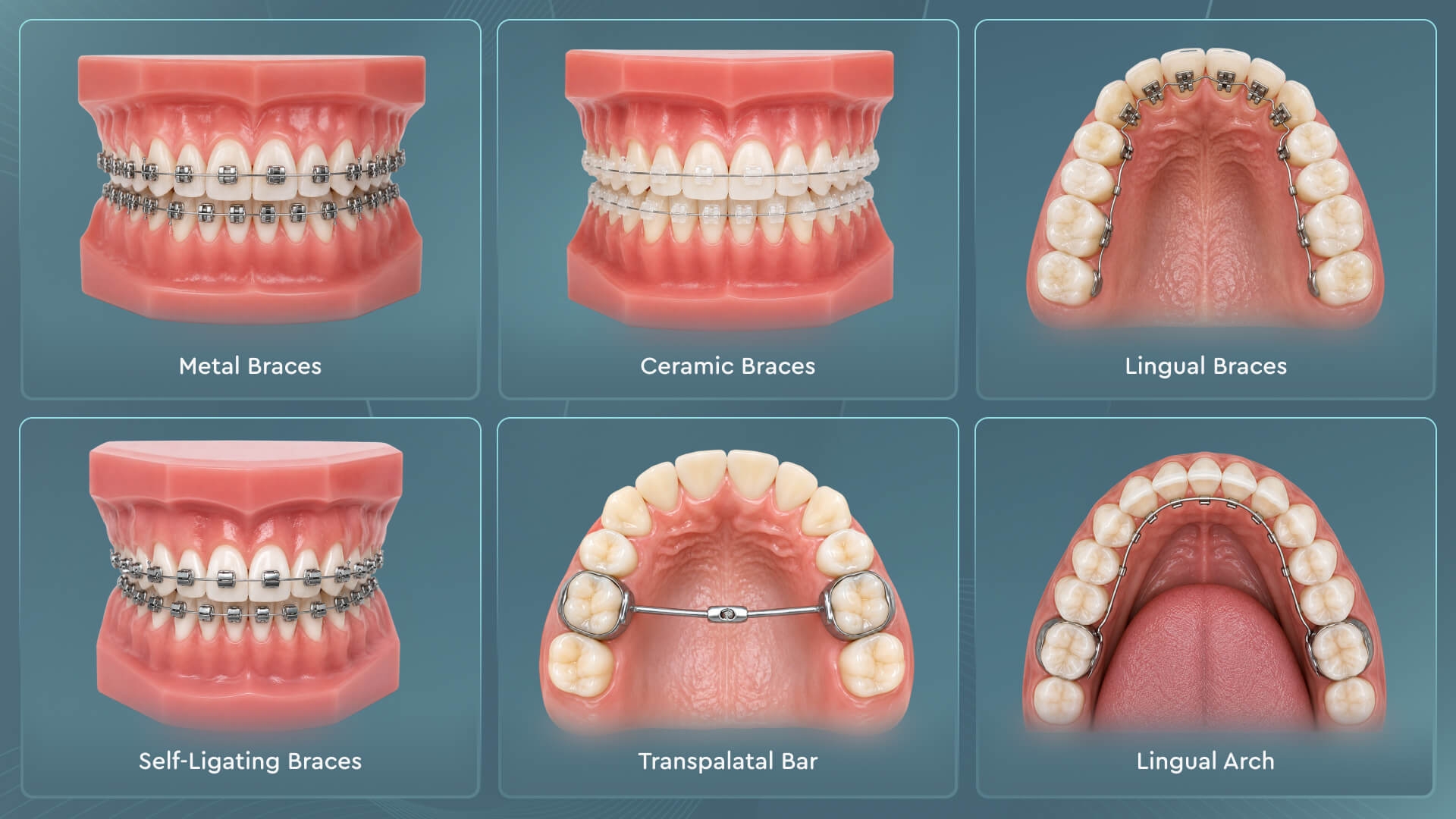
Metal braces remain the most recognized form of orthodontic treatment. Small brackets attach to each tooth, and an archwire runs through them, held in place by elastic ligatures.
They handle a broad range of alignment and spacing problems. The design is proven, durable, and effective even in complex malocclusion cases.
Patients need to pay closer attention to hygiene with metal braces. Food traps easily around brackets and wires, so daily brushing and flossing take extra time and care.
Ceramic Braces
Ceramic braces work the same way as metal braces but use tooth-colored or translucent brackets instead. Many patients choose them for a less visible option that still delivers full results.
The trade-off is durability and cost. Ceramic brackets chip more easily than stainless steel, and the material typically raises the price of treatment.
Lingual Braces
Lingual braces sit on the back of the teeth, facing the tongue rather than the cheek. This placement hides the appliance almost completely from view.
Each bracket is custom-made to match the shape of the tooth it sits on. Lingual braces treat most of the same corrections as traditional braces, though they can be harder to clean and may feel uncomfortable at first due to tongue contact.
Self-Ligating Braces
Self-ligating braces use a small clip built into the bracket instead of elastic ligatures. This clip holds the archwire in place while allowing it to slide with less friction.
Adjustment visits tend to run shorter, since there are no elastic ligatures to remove and replace. Claims of faster overall treatment or reduced discomfort are more contested — systematic reviews have largely found no significant difference from conventional brackets.
Fixed Space Maintainers
Space maintainers hold room in the arch, especially in children with a mix of baby and adult teeth. Several designs serve this purpose:
-
Transpalatal bar / Nance appliance — a metal bar attached to bands on the upper first molars, used to maintain arch width.
-
Lingual arch — a metal bar attached to bands on the lower first molars, used when baby teeth are lost early and space needs protecting.
Both designs prevent neighboring teeth from drifting into a gap before the permanent tooth erupts.
Fixed Retainers
Fixed retainers are thin wires bonded to the back of the front teeth once braces come off. They hold teeth in their corrected position during the retention phase.
A lower fixed retainer typically stays in place for at least two years, sometimes longer. An upper fixed retainer often gets used for patients who had a noticeable gap between their front teeth before treatment.
Removable Appliances
Removable appliances give patients control over when the device is in or out. That flexibility makes daily eating and cleaning easier, but it also puts more responsibility on the patient to wear the appliance as prescribed.
Clear Aligners
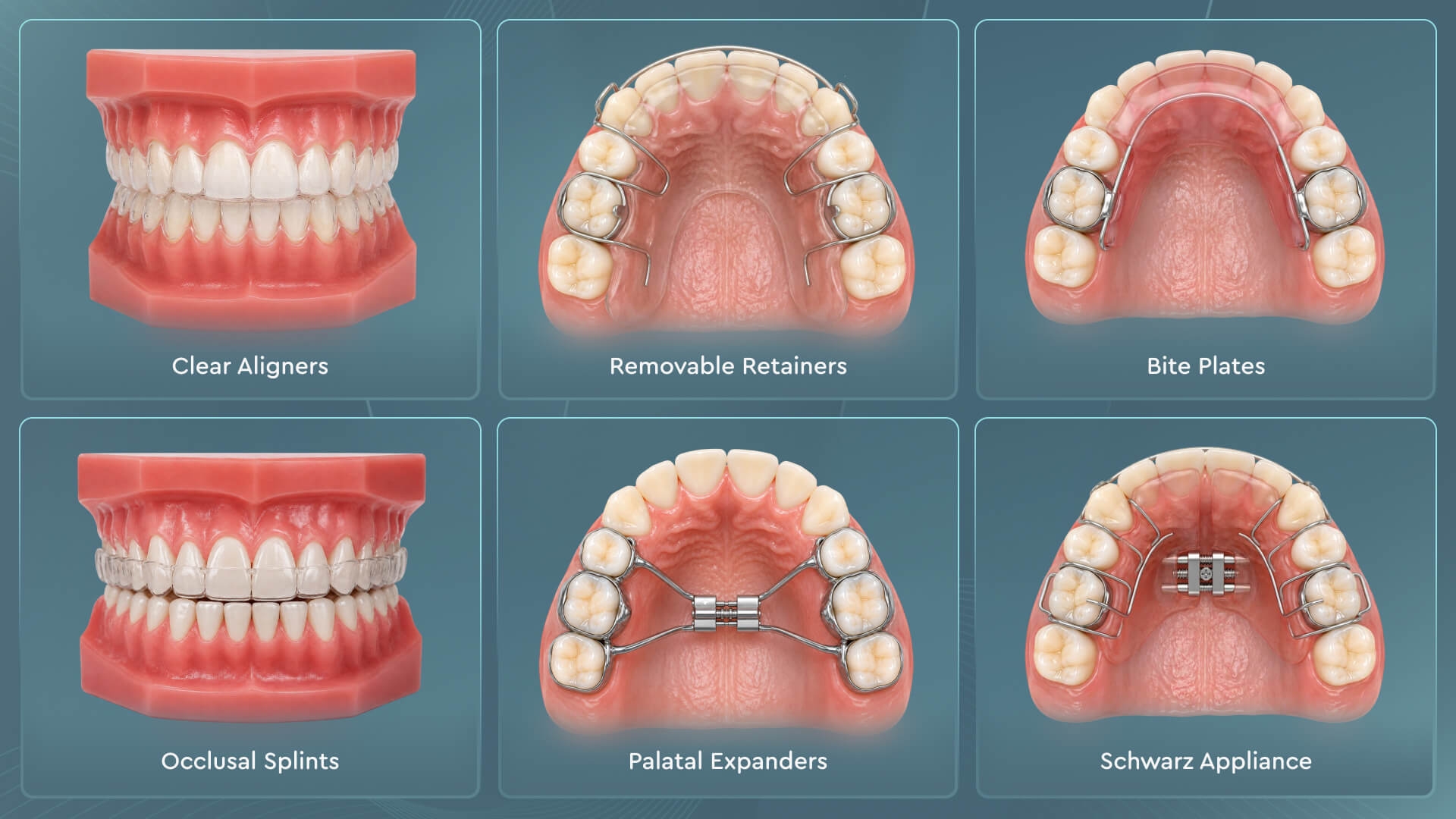
Clear aligners are thin, nearly invisible trays that fit snugly over the teeth. A series of trays moves the teeth through carefully staged steps, with each tray worn for one to two weeks before the next.
They work best for adults and teens with mild to moderate alignment issues — crowding, spacing, and minor bite problems. Because patients remove them to eat, aligners make daily hygiene noticeably simpler than fixed appliances.
With SoftSmile VISION, clinicians plan and stage clear aligner treatment with full clinical control, AI-assisted optimization, and a direct path into aligner production. For a full breakdown of the process, see our clear aligner treatment planning guide.
Removable Retainers
Removable retainers hold the result in place after active treatment ends. Several designs exist, and most follow a similar wear pattern: full-time for the first few months, then nights only.
Consistent wear is what prevents relapse. Teeth drift back toward their original position faster than most patients expect once active treatment stops.
Biteplanes
Biteplanes reduce a deep overbite by keeping the back teeth from fully closing together. The design combines wire and acrylic, and can be either removable or cemented in place.
They work best when worn continuously, not just part of the day.
Bitesplints
Bitesplints are custom-fit acrylic appliances worn over the teeth, most often prescribed to manage temporomandibular joint (TMJ) disorders and bruxism (teeth grinding/clenching). They stabilize the jaw, ease muscle tension, and protect teeth from wear. They're generally a standalone device rather than an adjunct to braces, though orthodontic patients with TMD symptoms may use one alongside active treatment.
Palatal Expanders
Palatal expanders widen the upper jaw so the top and bottom teeth meet correctly. Clinicians also call this device a rapid palatal expander or rapid maxillary expansion appliance.
Expanders work best in growing patients, before the suture running down the center of the palate fuses. Once that suture closes, expansion becomes far more difficult to achieve without surgery.
Functional Appliances
Functional appliances guide jaw growth rather than simply moving teeth. They play a central role in dentofacial orthopedics, correcting skeletal discrepancies while the patient is still growing.
Some functional appliances are fixed to the teeth; others come out for cleaning. Both types work by changing the position of the jaw during function, which shapes how the bone develops over time.
Activator Appliance
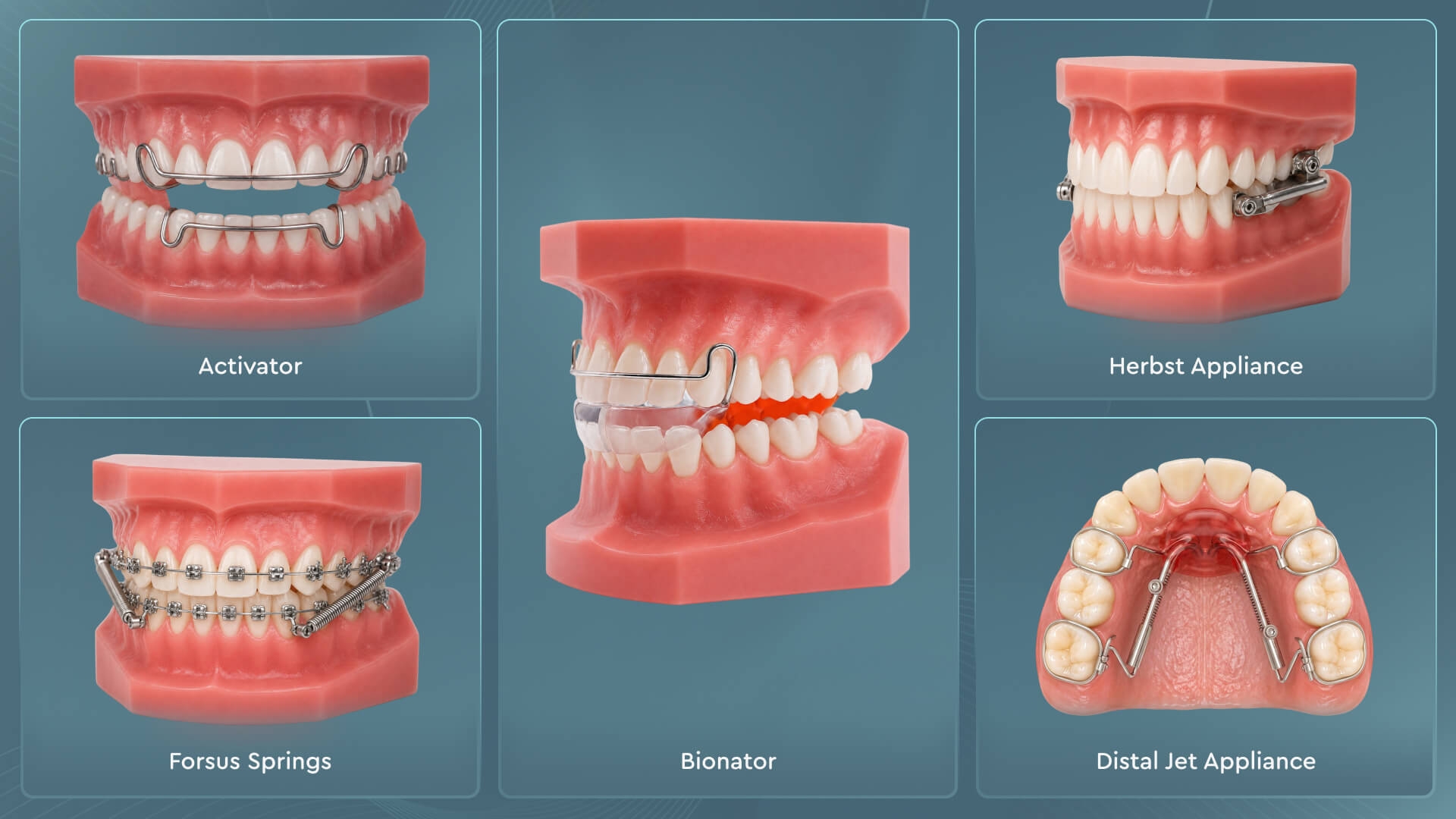
Viggo Andresen developed the activator in 1908, and it became the first widely accepted functional appliance in orthodontics. This removable device guides jaw growth and corrects Class II malocclusions, where the upper jaw sits ahead of the lower jaw.
Bionator
Wilhelm Balters modified Andresen's activator in the 1950s to create the bionator. Clinicians use it for the same purpose — correcting Class II malocclusions — while promoting more mandibular growth than the original design.
Herbst Appliance
Emil Herbst introduced this fixed functional appliance in 1905. It corrects Class II malocclusions by holding the mandible in a forward position.
Hans Pancherz revived interest in the Herbst appliance in the 1970s, and it remains a common choice for growing patients with a retruded lower jaw today.
Schwarz Appliance
The Schwarz appliance is a removable functional device that widens the upper dental arch by stimulating bone growth along the palate. Like palatal expanders, it only works before growth is complete.
Clinicians prescribe it during active growth, never after.
Forsus Springs
Forsus springs are fixed appliances used when the upper teeth sit noticeably ahead of the lower teeth. They produce an effect similar to rubber bands, pulling the bite into better alignment over time.
Clinicians often choose Forsus springs as a compliance-free alternative to headgear or elastics from the start of treatment, since the fixed design doesn't depend on the patient remembering to wear it. It's frequently a first-line choice rather than a fallback.
Distal Jet Appliance
The distal jet gradually shifts the upper molars backward, creating space for other teeth to erupt properly. The design includes metal components, an acrylic piece resting on the roof of the mouth, and a spring mechanism that drives the movement.
Auxiliary Appliances and Components
Several smaller devices support the main appliance rather than replace it. Each one addresses a specific mechanical need during treatment.
Elastics (rubber bands) move the upper and lower teeth relative to each other, correcting overbites, underbites, and other bite discrepancies. Inconsistent wear is one of the most common reasons treatment runs longer than planned.
Headgear treats a protruding upper jaw or an underbite by applying external force to guide growth. Clinicians use it less often today than in past decades, but it still has a place in certain skeletal cases.
Spacers (separators) are small rubber rings placed between teeth to create room for orthodontic bands. Clinicians remove them once the bands are ready to go on.
Mouthguards protect the teeth and appliance from injury during sports. They matter even more for orthodontic patients, since a direct hit can damage brackets or wires.
How to Choose the Right Orthodontic Appliance
Appliance selection depends on more than the malocclusion itself. Several factors shape the decision:
-
Severity and type of malocclusion — mild spacing calls for a different approach than a skeletal Class II discrepancy.
-
Patient age and growth potential — functional and expansion appliances only work while the patient is still growing.
-
Patient compliance — removable appliances demand more discipline than fixed ones.
-
Aesthetic preferences — some patients prioritize a discreet option, even if it costs more or takes longer.
-
Cost — treatment budgets often narrow the realistic options.
Fixed appliances suit complex cases and patients who may not wear a removable device consistently. Removable appliances fit mild to moderate cases where the patient can be trusted to wear the device as prescribed. Functional appliances apply specifically to growing patients with a skeletal component to correct.
Digital treatment planning has changed how clinicians make this call. Software like SoftSmile VISION lets you simulate outcomes across different appliance types before committing to one, comparing predicted results side by side. Clear aligners handle mild to moderate cases well, while complex malocclusions often still need fixed appliances or a combined approach.
"Modern orthodontics increasingly uses hybrid protocols — for example, combining aligners with fixed appliances or temporary anchorage mini-implants. This approach draws on the strengths of each method and compensates for their limitations. Planning hybrid treatment requires a deep understanding of biomechanics and experience working across different systems."
Dr. Luca Galli, Orthodontist, Clinical Consultant at SoftSmile
The Role of Digital Technology in Appliance Selection and Planning
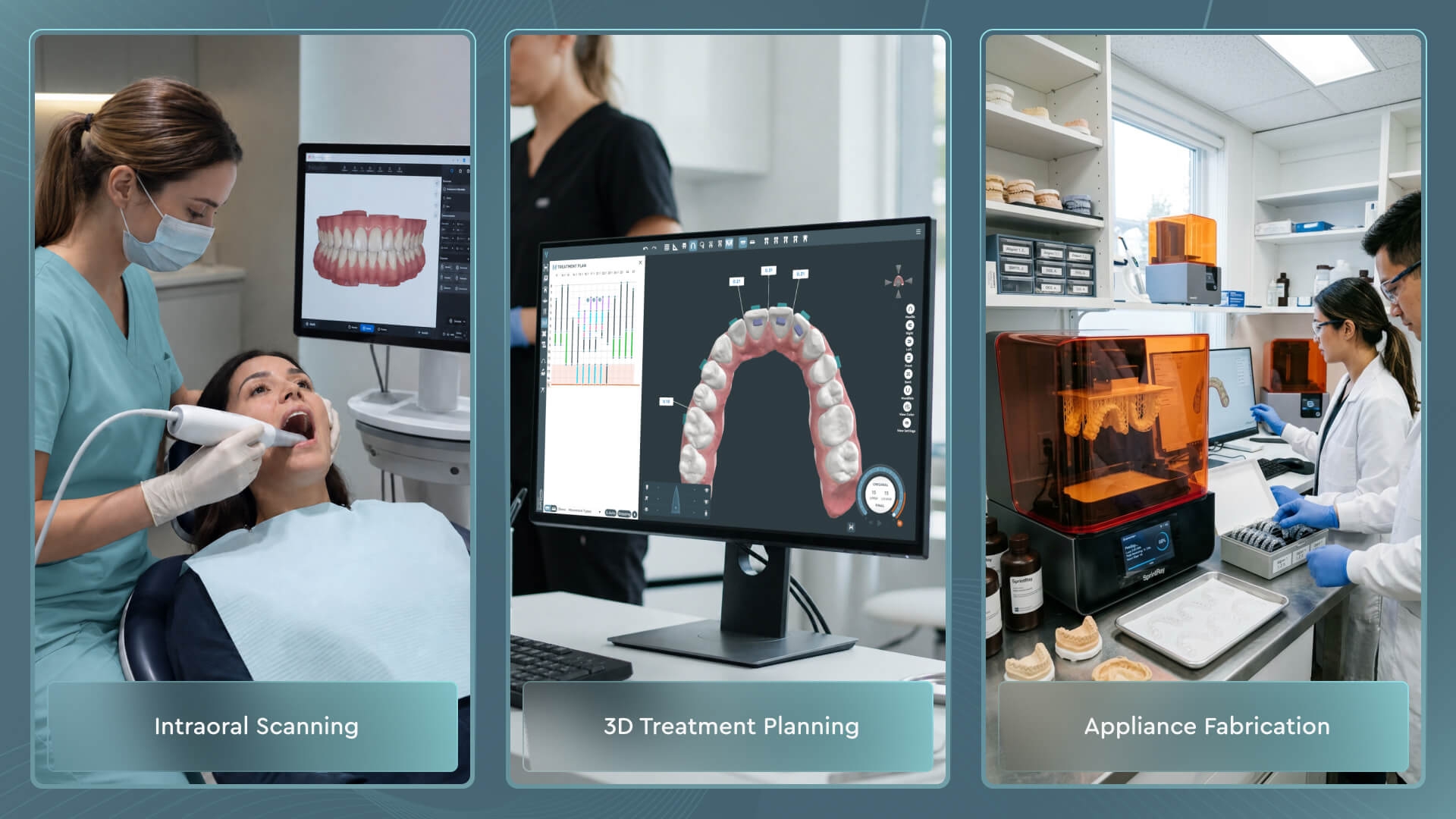
Digital tools have reshaped how clinicians choose and plan orthodontic appliances. Intraoral scanners capture precise digital impressions in minutes, replacing the messy trays and materials of traditional impressions.
Treatment planning software builds on that data, simulating tooth movement and staging before any appliance goes into production. This lets a clinician test different approaches on screen and settle on the one that fits the case best.
Artificial intelligence adds real speed to the process. Automated segmentation, staging suggestions, and attachment placement all run through AI-assisted workflows now, cutting hours of manual work down to minutes. These tools also tighten coordination with the lab. Digital files move faster than physical models, which shortens turnaround and keeps larger caseloads manageable.
SoftSmile VISION offers this full range of functionality while keeping clinical control in the clinician's hands. The software is FDA-cleared and built by doctors, for doctors — see our guide to orthodontic software for a closer comparison. Clinicians can plan clear aligner treatment from the first scan through final staging, then send the case to SoftSmile's in-house production service without switching platforms.
"Modern digital planning allows for simulating treatment outcomes before the appliance is even manufactured. This makes it possible to compare different scenarios — brackets, aligners, or a hybrid approach — and choose the best solution for each patient. Combining intraoral scanning with CBCT makes the process precise and predictable."

Orthodontic Appliances Checklist
Use this list as a quick reference for the appliances covered in this guide, organized by category.
Fixed Appliances
-
Metal braces
-
Ceramic braces
-
Lingual braces
-
Self-ligating braces
-
Transpalatal bar / Nance
-
Lingual arch
-
Fixed retainer
Removable Appliances
-
Clear aligners
-
Removable retainer
-
Biteplane
-
Bitesplint
-
Palatal expander
Functional Appliances
-
Activator
-
Bionator
-
Herbst appliance
-
Schwarz appliance
-
Forsus springs
-
Distal jet
Auxiliary Components
-
Elastics
-
Headgear
-
Spacers / separators
-
Mouthguard
Digital Tools for Planning
-
Intraoral scanner
-
Treatment planning software (e.g., SoftSmile VISION)
-
AI-assisted staging and segmentation

Frequently Asked Questions About Orthodontic Appliances
What is the difference between fixed and removable appliances?
Fixed appliances bond to the teeth and stay in place until a clinician removes them. Removable appliances can be taken out by the patient for eating and cleaning, which makes hygiene easier but depends on consistent wear.
How long do I need to wear a removable retainer after treatment?
Most patients wear it full-time for the first few months, then shift to nights only. Many orthodontists recommend indefinite nighttime wear... (Fixed retainers, by contrast, stay bonded in place continuously and are only removed by a clinician.)
Are clear aligners as effective as traditional braces?
For mild to moderate cases, clear aligners produce results comparable to braces. More complex malocclusions still often need fixed appliances, or a hybrid approach that combines both.
What are the signs that an appliance needs adjustment?
Watch for a loose bracket or wire, unusual pain beyond the first few days, or teeth that aren't tracking as expected. Any of these calls for a visit before the next scheduled appointment.
Can adults use functional appliances?
Functional appliances depend on active jaw growth, so they work best in children and teens. Adults with a similar skeletal discrepancy typically need a different approach, such as fixed appliances, aligners, or a surgical option.
How does digital treatment planning improve appliance selection?
Digital planning lets clinicians simulate outcomes with different appliance types before starting treatment. This makes it easier to compare a bracket-based approach against aligners or a hybrid plan, and to choose the option most likely to succeed for that specific patient.


Sign up for our newsletter!
Case Studies, Podcasts, Ebooks, Events, Webinars, Company news, and more...
By subscribing you agree to the Terms of Use and Privacy Policy.


