


|
Stage |
What usually goes wrong |
Who should own it |
Best channel |
|---|---|---|---|
|
First inquiry / call |
Slow callback; no clear answer on what the first visit includes |
Front desk |
Phone, then SMS confirmation |
|
New-patient consult |
Treatment framed as cosmetic only; too much clinical detail, too little check of understanding |
Treating doctor + treatment coordinator |
In person |
|
Treatment & financial presentation |
Fees discussed before the patient understands the plan |
Treatment coordinator |
In person, with a written summary to take home |
|
Start of treatment (attachments, first trays) |
Wear time and attachment care explained once, verbally |
Clinical assistant |
In person + printed or portal instructions |
|
Active treatment (tray changes, elastics, missed visits) |
Silence between visits; no-shows go unaddressed |
Treatment coordinator |
SMS, portal |
|
Refinements |
Presented as a surprise and read by the patient as a mistake |
Treating doctor |
In person, with the plan on screen |
|
Retention |
Retainer wear framed as optional; recall drifts |
Clinical assistant + front desk |
In person, then SMS recall |
November 27, 2026
How to Improve Dental Patient Communication: From the First Call to the Final Retainer
What to say at the consult, what to send between visits, which tools handle which part of the conversation, and how to tell whether patient communication is actually improving.

SoftSmile Team
Editorial Team

Most dental patient communication problems do not show up in the chair but three days after the consult, when the patient tries to explain attachments to a spouse and cannot, or when a parent asks at dinner why the aligners are back in their case. For U.S. aligner practices, much of treatment happens at home, so communication is judged by what the patient can repeat, not only by what the treating doctor said. This guide walks through what to say at the consult, what to send between appointments, which tools fit which part of the job, and how to tell whether any of it is working.
Why Patients Leave the Consult With a Different Story Than Yours
A treating doctor can walk through a plan carefully and still hear a different version back at the first fitting, with the patient remembering the fee and "about a year" but not why six teeth will get small bumps. What looks like a lapse in attention often reflects the distance between what was said in the chair and what someone can repeat at home a few days later.
Health literacy is part of that gap, and since 2020 the CDC has defined it on two levels, personal and organizational, which makes clear explanation part of the practice's responsibility rather than the patient's alone.
The most cited U.S. figure still comes from the National Assessment of Adult Literacy (NCES), in which about 36% of adults scored at basic or below-basic health literacy. Those data date from 2003, so they are best read as directional, not as an estimate of understanding among today's orthodontic patients.
Orthodontic plans raise the stakes, since attachments, IPR, elastics, and refinements are small decisions the patient must act on for a year or longer. In patient communication in dental practice, misunderstandings tend to surface between visits, when patients follow instructions without immediate support, or after the consult, when the plan is discussed with someone else involved in the decision.
Where Communication Breaks Across the Treatment Journey
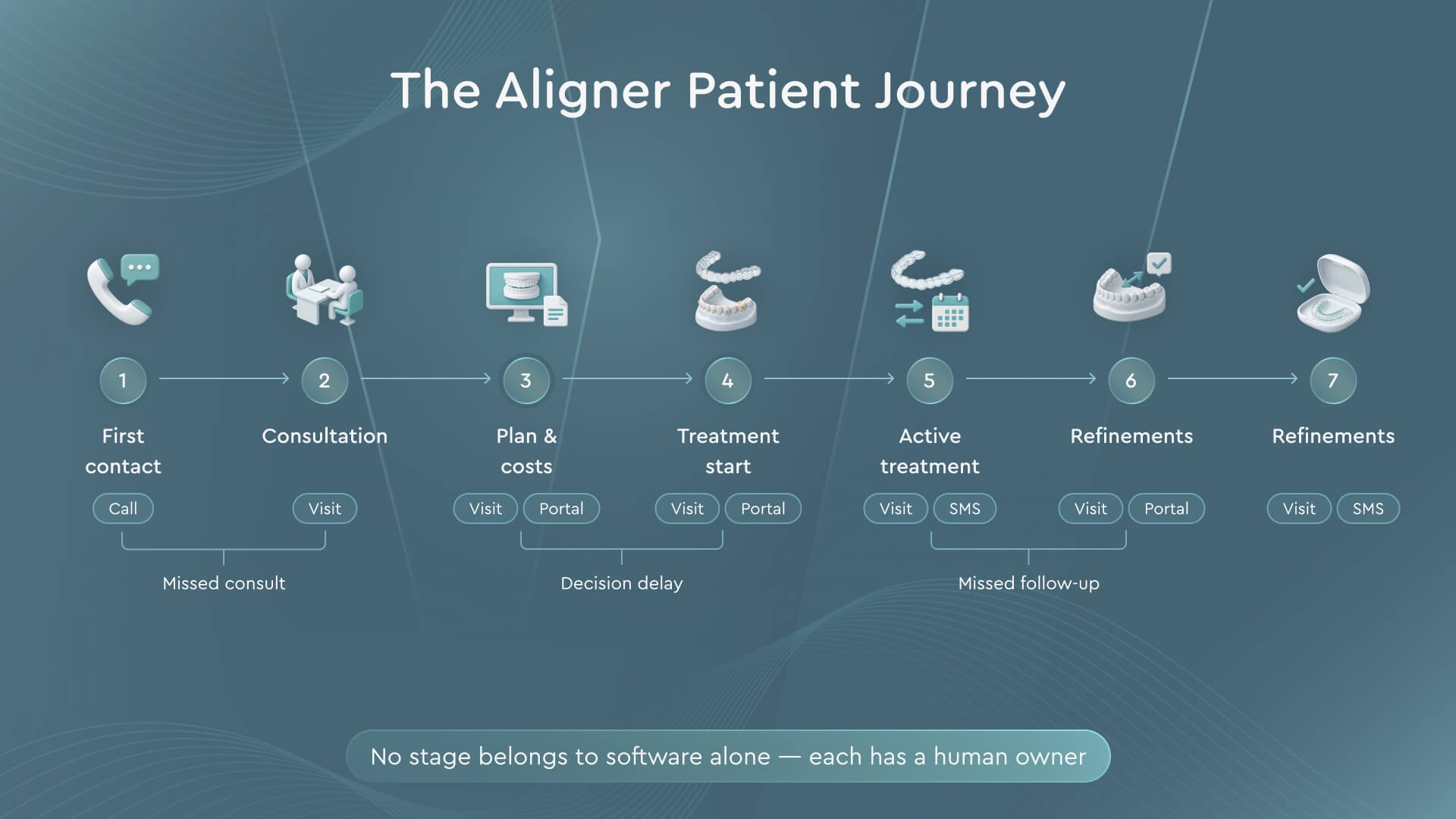
The table maps seven stages of aligner treatment, showing common communication gaps, responsible team members, and preferred channels.
Across the two right-hand columns, a pattern appears: software is a channel, never an owner. A reminder tool can send a tray-change message, but someone on the team still follows up when the patient does not respond.
Roles should be agreed in advance, with a name next to every row; otherwise a stage falls to whoever answers the phone that day, and patients hear mixed messages before the practice recognizes a gap in its communication process. Retention needs an owner too, so patients know whom to contact about their retainers after treatment ends.
Explaining the Treatment Plan So the Patient Can Repeat It Back
The consult is where most of the plan is explained, which makes it the easiest place to start for any practice working out how to improve dental patient communication without new tools or extra staff. A good explanation is one the patient can retell accurately at home, without the treating doctor in the room, and five habits make that far more likely.
Start With Why Treatment Is Needed
Before the mechanics, the patient needs to understand the diagnosis. Many adults come in for the look of their smile and have never heard their bite described in clinical terms, so the first job of the consult is to name what the doctor found and why it matters for their teeth and gums over time. Framing the plan around those findings changes how every later detail is heard: attachments, IPR, and elastics read as steps toward a clinical goal, and the fee is weighed against a health problem as well as an esthetic one. Functional findings, such as how the teeth meet and how the jaw moves, belong in the same conversation, presented as part of the assessment rather than as a promise of what treatment will resolve.
Plain Language for Attachments, IPR, and Elastics
Start by translating each clinical term into what it does for the patient, and only then introduce the word itself, so that the patient recognizes it later. Attachments become "small tooth-colored shapes bonded to selected teeth that help the aligners apply forces for specific tooth movements," while IPR becomes "carefully removing a small, prescribed amount of enamel between certain teeth to create space for planned tooth movements." Attachments are made of composite resin and are removed at the end of treatment. IPR deserves a little more time, since it is the step patients worry about most: enamel is removed in fractions of a millimeter, within safe limits, and any sensitivity afterward is usually mild and temporary.
Elastics, in turn, become "small rubber bands worn between the upper and lower arches to help guide bite correction." They attach to buttons or cutouts in the aligners, are typically changed daily, and work only when worn as the treating doctor prescribes. What each version adds is a reason, which is usually the part that gets dropped when an explanation is rushed, even though patients follow instructions far more consistently when they understand their purpose.
Teach-Back — Ask the Patient to Explain It to You
Teach-back, Tool 5 of the AHRQ Health Literacy Universal Precautions Toolkit, checks understanding by asking patients to describe in their own words what they need to know or do. The most common mistake is to treat "Do you have any questions?" or "Does that make sense?" as a check, although AHRQ states plainly that yes-or-no questions do not count, since patients tend to answer yes either way.
The question works best framed as a check on the explanation rather than a quiz, and at the end of an aligner consult it might sound like this:
Coordinator: We covered a lot today, so let me make sure I explained it well. When you get home and someone asks what those bumps on your teeth are for, what will you tell them?
Patient: That they help the aligners grip?
Coordinator: Exactly, they give the aligner something to push against. And how long should you wear your aligners each day?
Patient: Most of the day… I take them out to eat.
Coordinator: Your prescribed wear schedule is 20 to 22 hours a day, with removal for eating, drinking anything other than water, and oral hygiene. Consistent wear supports the planned treatment. Brush your teeth, or at least rinse your mouth, before reinserting your aligners. Remove aligners before drinking hot beverages, as heat can deform the plastic.
In this example, the coordinator clarifies the prescribed wear time rather than moving on; the broader lesson is to treat a vague answer as a cue to explain again, not as agreement.
Show the Plan Instead of Describing It
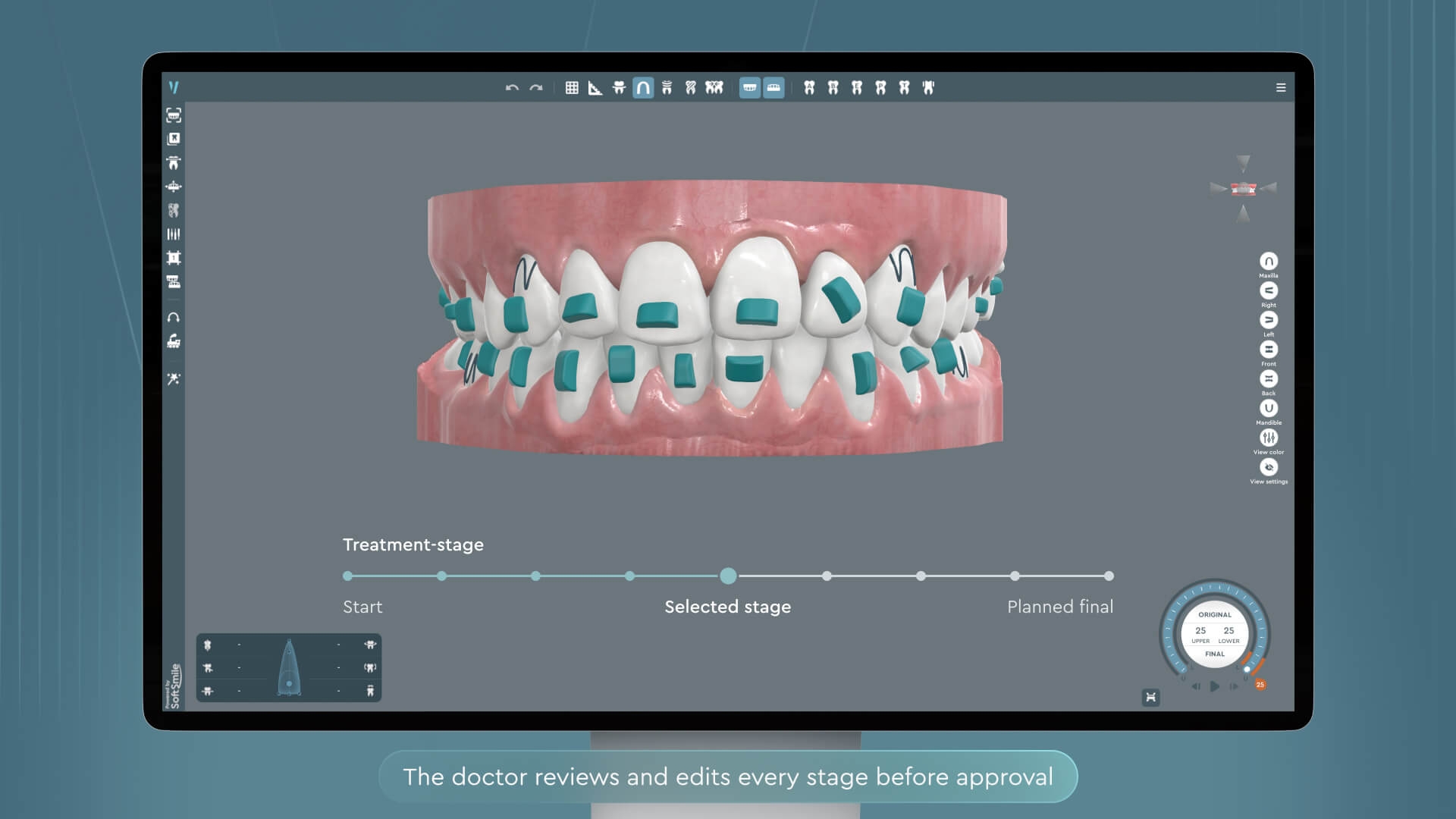
An intraoral scan and staged 3D simulation make tooth movements easier to explain, so patients can review attachment placement and ask questions before treatment begins (see our our step-by-step guide to digital orthodontic treatment planning). Overlaying the patient’s photo on the scan and showing planned before-and-after views stage by stage help connect each phase to a visible change.
3D treatment simulation in VISION — the treating doctor can review and adjust proposed tooth movements, while WebViewer provides browser-based access for reviewing the plan with patients. A simulation should be presented as a proposed treatment plan rather than a guaranteed outcome, with the treating doctor responsible for clinical review and final approval. Biological responses vary between patients, so some planned movements, particularly rotations of rounded teeth and extrusions, may not be fully expressed, which is one reason additional assessment or refinements may be needed during treatment.
“Before I show a patient a single tooth moving on screen, I explain why we’re treating at all. Crowding that traps plaque, a deep bite that’s wearing down the lower incisors, a crossbite that’s pushing the gum back on one tooth. Most patients have never heard their bite described as a health issue. Once the reason is clear, the setup is much easier to follow, because every attachment, every IPR contact and every elastic is tied to one of those goals.”

The Money Conversation
The financial conversation is best kept separate from the clinical one, ideally led by the treatment coordinator after the treating doctor has left the room, since what looks like a financial objection often reflects a plan the patient never fully understood.
Anything that could surprise the patient later is best covered before signing: whether refinements are included, how many this case typically needs, what retainers cost, and how missed wear time affects the fee. A take-home summary makes the fee part of the plan, not an appendix to it.
The same logic applies to what might happen during treatment. Common events, such as an attachment debonding, a few days of soreness with each new set, a slight lisp at the start, small dark triangles appearing between teeth that were overlapped, or the need for additional aligners, are easier to accept when the patient heard about them before signing. Discussed at the consult, they become part of the plan rather than a deviation from it.
One Voice per Patient
Each patient is best served by one owner for communication, usually the treatment coordinator. The treating doctor steps in at clinical decision points: the plan, a refinement, an unexpected finding.
Conflicting messages can undermine patient confidence. If the front desk says "about a year," the assistant says "it depends," and the treating doctor says "14 months," the patient may question the plan.
Orthodontic Patient SMS Communication: Reminders, Wear Checks, and Consent

According to Pew Research Center, 91% of U.S. adults owned a smartphone in 2026, which makes orthodontic patient SMS communication a practical channel between visits.
Messages that work are short and tied to a single action. Most practices need the same core set:
-
Appointment reminder
-
Tray-change nudge
-
Elastics or wear-time check-in
-
Post-attachment care tips (first 48 hours)
-
After-hours "lost or broken aligner" instructions
-
Refinement scan reminder
-
Retention check and retainer recall
In both pairs below, the weak version carries clinical detail or blame that has no place in an unencrypted message:
Weak: "Hi [Full name], case #[ID]: time for aligner 7 of 24. Dr. [Name] noted poor tracking on your upper right incisor. Wear them 22 hrs."
Better: "Hi [First name], it's [Practice]. If today is your scheduled aligner-change day, follow your doctor's instructions for your next set. Questions? Call [number]. Reply STOP to opt out."
Weak: "Are you wearing your elastics? The doctor noticed you're behind."
Better: "Quick check-in from [Practice]: how are the elastics going this week? Reply 1 if all good, 2 if you'd like a call."
Teen cases need two contact tracks: the parent usually receives scheduling, billing, and consent messages, while the teen gets wear nudges. It is worth recording which number consented to which message type and confirming with the parent that the teen may be texted directly.
A STOP reply needs a clear protocol. Under FCC rules, consumers may revoke consent to automated calls and texts using recognized methods, and an FCC order effective November 25, 2026, allows callers, under specified conditions, to apply an opt-out to one category of informational messages rather than all of them. Practices should document every opt-out and check their workflows against the rules in effect when messages are sent. FCC overview of telemarketing and robocall rules.
HHS allows covered providers to communicate electronically with patients when reasonable safeguards are in place, and practices may need to accommodate requests for other communication methods. Unencrypted messages should leave out unnecessary sensitive details, and a messaging vendor acting as a business associate needs a Business Associate Agreement. The minimum necessary standard does not apply to disclosures made to the patient, though other safeguards still do. HHS guidance on electronic communication. HHS minimum necessary guidance.
This overview is not legal advice; healthcare counsel should review the practice’s consent, opt-out, and messaging policies.
Dental Patient Communication Software: Categories and How to Choose
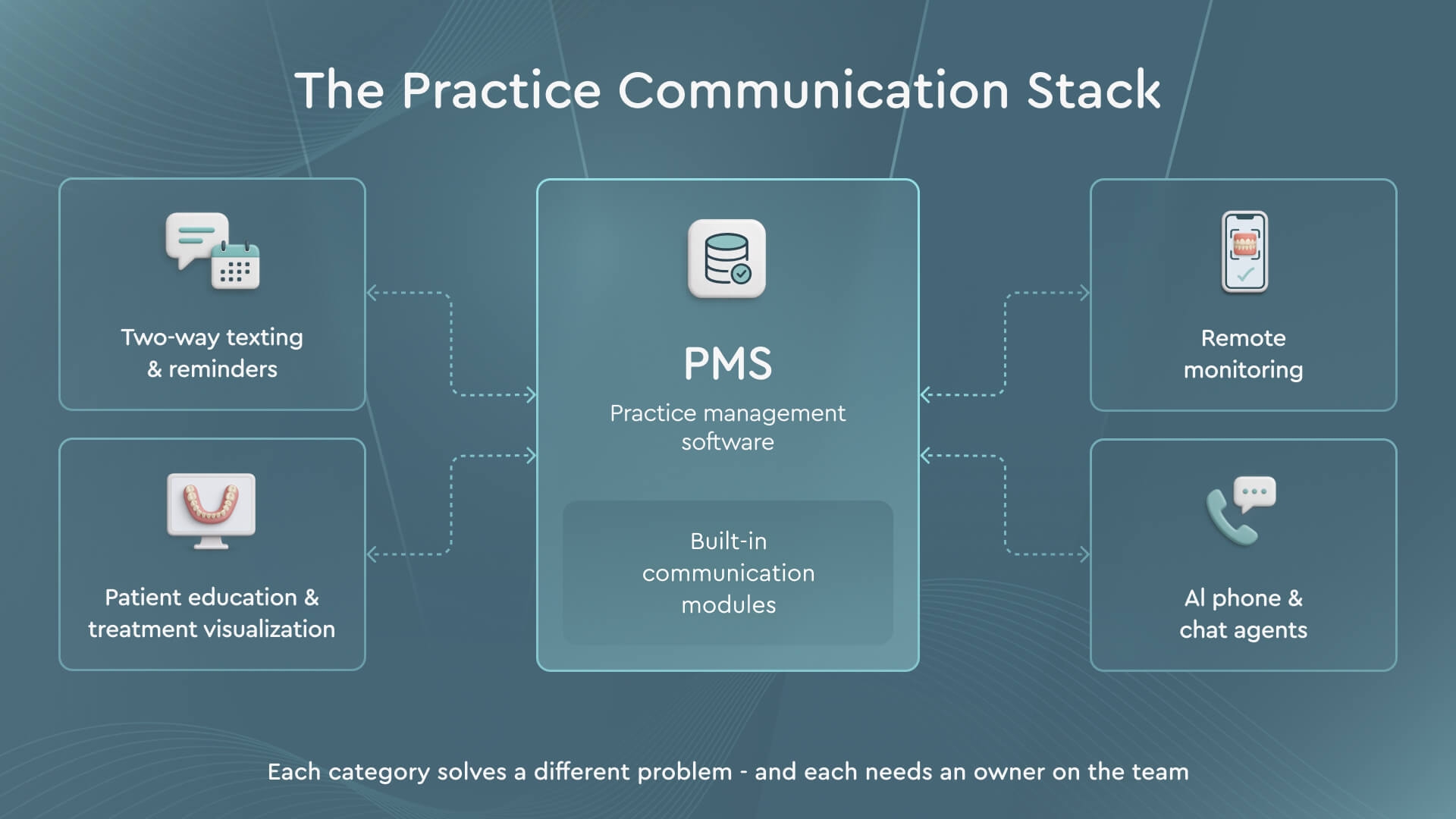
Dental patient communication software covers different parts of the patient journey. The table groups these tools by function rather than vendor.
|
Category |
What it handles |
Typical examples |
What it doesn't do |
|---|---|---|---|
|
Two-way texting and reminder tools |
Appointment reminders, confirmations, recalls, two-way SMS from the office number |
Weave, Solutionreach, NexHealth |
Explain the clinical plan or track tooth movement |
|
Communication modules inside practice management software |
Reminders, forms, and messages tied to the schedule and patient record |
Built into many orthodontic PMS systems |
Advanced two-way texting or visual case presentation, depending on the system |
|
Patient education and treatment visualization |
3D treatment simulation, staged plan review, shareable links to the plan |
SoftSmile VISION / WebViewer |
Send reminders or manage scheduling |
|
Remote monitoring |
Smartphone-based intraoral scans between visits, aligner fit and tracking checks |
DentalMonitoring |
Replace the treating doctor's clinical review |
|
AI phone and chat agents |
Answering calls and texts, booking, routine questions after hours |
Weave AI Receptionist |
Make clinical judgments or deliver difficult news |
Practice management software connects scheduling and patient records with other communication tools. For practical ways to put these systems to work, see our guide to improving orthodontic practice efficiency with digital technology.
Before adding any dental patient communication tool, it is worth running through a short checklist. The best dental patient communication in an aligner practice often depends on consistent, well-timed messages and clearly assigned responsibilities. A new tool should make that routine easier rather than more complicated.
Where HIPAA is involved, it helps to establish whether the vendor will act as a business associate and, if so, whether it will sign a Business Associate Agreement (BAA). Appointments, confirmations, and opt-outs should sync both ways with the practice management system rather than living in two places.
From there, the checklist covers conversation access, two-way messaging, reporting on response times and opt-outs, and who will manage the tool after launch.
AI in Patient Communication: What to Delegate and What to Keep
AI can take on repetitive administrative work: after-hours calls, scheduling, routine reminders, and sorting incoming messages for the team. A dental AI patient communication tool works from responses the practice has approved. Questions about aligner wear, symptoms, or treatment go to the treating doctor, who stays in charge of every decision about the case.
Patients seem to share this view. A Pew Research Center survey of 3,488 U.S. adults conducted June 22–28, 2026, found that 60% are uncomfortable with AI in their own healthcare for tasks such as diagnoses and treatment, while 73% are open to AI scheduling an appointment: 29% on its own and 44% if a person reviews it first. Pew Research Center (October 29, 2026).
Whatever the tool sends, the practice remains responsible for its content, so AI agent scripts, escalation rules, and a monthly sample of conversations are best reviewed by the team. Used this way, AI assists the team rather than replacing clinical decisions, the same principle our overview of AI dental software applies to diagnostics and treatment planning.
Refinements and Plan Changes: The Conversation Most Practices Under-Prepare
Patients often read a refinement as a sign that something went wrong, especially if no one mentioned the possibility at the consult. The groundwork is laid months earlier, at case presentation: refinements are a normal part of aligner therapy, and the plan may change as the teeth respond.
In a common scenario, a patient on tray 14 admits she skipped most of a two-week vacation, and the next tray no longer seats. The treating doctor assesses fit and tracking, then decides whether a new scan or a plan adjustment is needed. The conversation starts with the clinical findings and the original plan next to current tooth positions. Not blaming the patient does not mean leaving the missed wear unmentioned: the treating doctor addresses it calmly and explains how consistent wear affects tracking and the next phase.
In VISION, Matching compares a progress scan with planned tooth positions and highlights tooth-level deviations. The treating doctor reviews the findings and decides on the next step, and the comparison helps explain why a change is being considered without implying that every deviation needs a refinement.
“I talk about refinements at the first consult, not when they happen. I tell patients that teeth don’t always follow the plan exactly, that an attachment can come off, that we may need extra aligners, and that retainers are for the long term. If you say it before treatment, it’s information. If you say it for the first time halfway through, it sounds like an excuse. So when a refinement comes, I put the original plan next to the current scan and we go over what changed and what we do next.”
How to Tell Whether Your Communication Is Getting Better
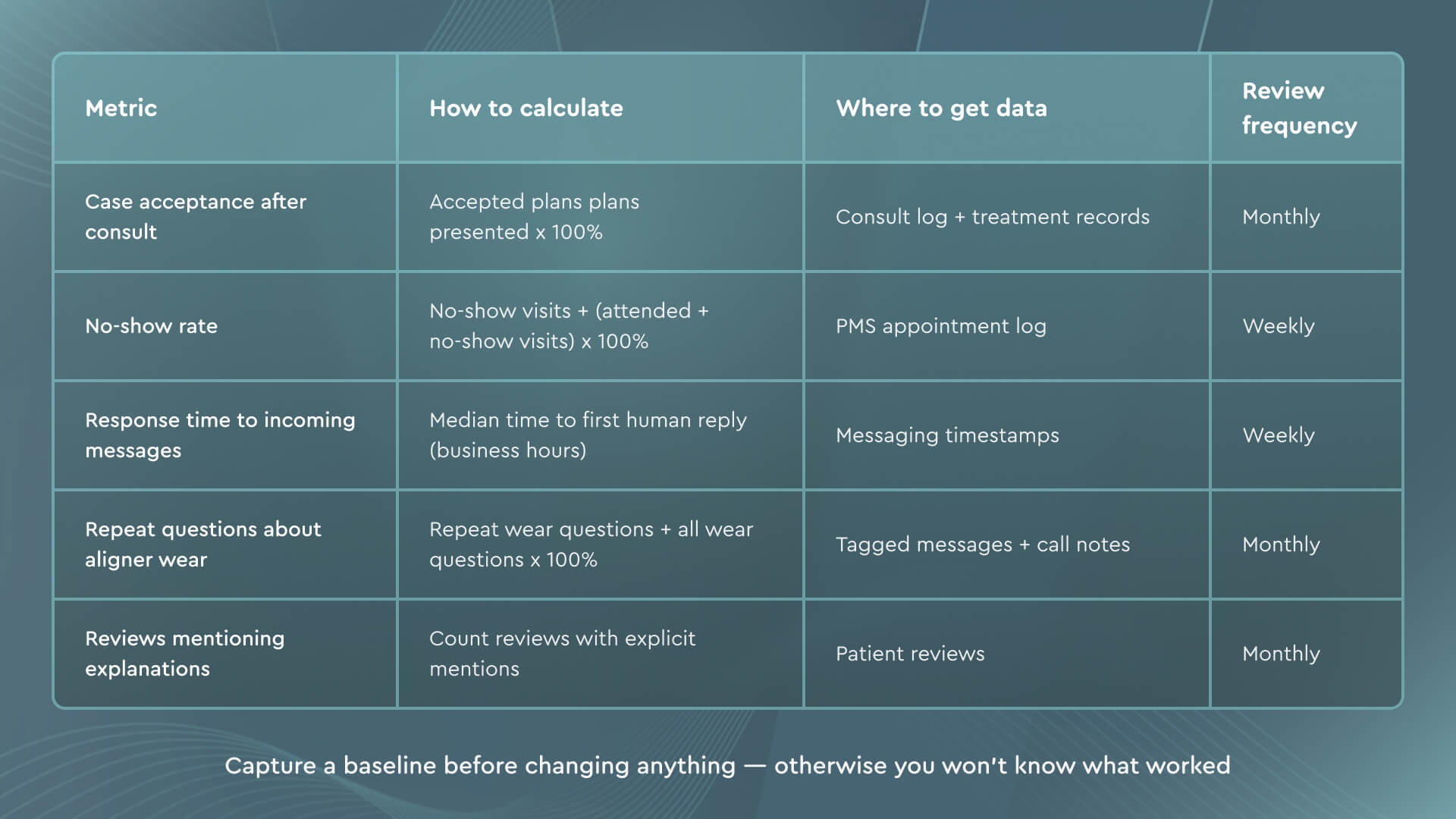
PMS and messaging data can reveal communication gaps over time, though none of these metrics measures patient understanding directly:
-
Case acceptance rate after the consult: the share of a consistently defined consult cohort that starts treatment within a set follow-up window, with start criteria and exclusions such as observation-only cases documented and results tracked by coordinator and case type.
-
No-show rate: missed appointments divided by scheduled ones, split by new and active patients.
-
Response time to incoming messages: median time from a patient's text to a human reply during office hours.
-
Repeat aligner-care questions: the share of inbound messages that repeat an answered question about wear time, tray changes, or attachments, tagged consistently.
-
Reviews mentioning explanations: the share of reviews that describe clear explanations, read against total review volume.
A baseline is best captured before anything changes and then compared using the same definitions and follow-up windows, bearing in mind that these measures shift for many reasons, so a before-and-after comparison does not on its own prove cause. Most of the data comes from the PMS and the dental patient communication tool that sends the messages; outside benchmarks are worth using only from a dated source such as the ADA Health Policy Institute.
Where SoftSmile Fits in Patient Communication
SoftSmile's role in this article is treatment planning and visualization, not automated appointment reminders or practice-wide SMS campaigns. VISION gives the treating doctor a plan to review with patients and revisit as treatment progresses.
VISION supports AI-assisted scan processing and aligner treatment planning, with tools for reviewing tooth movements, attachments, elastics, and staging. The treating doctor reviews the proposed plan, requests or makes appropriate changes, and retains responsibility for approval. WebViewer lets the treating doctor and the patient review the proposed plan in a browser; Matching compares uploaded progress scans with planned tooth positions during treatment.
VISION Portal — case management, comments, review, and approvals in one place, so the treating doctor and collaborating teams work from the same treatment information. According to SoftSmile, more than 1,000 doctors have chosen its system; that figure is SoftSmile’s own reported benchmark, not an independent industry study. VISION holds FDA 510(k) clearance (K212770), while diagnosis, treatment recommendations, and plan approval remain the responsibility of the treating doctor.
Bottom Line
Better dental patient communication rarely comes from a new script or app alone, but from knowing where each stage of treatment breaks, giving every stage an owner, and checking that patients can repeat the plan back before they leave the room.
For a practice deciding how to improve dental patient communication this week, a good place to start is five consults, each ended with a single teach-back question and a note of what the patient got wrong. To see where a visual plan fits into that routine, book a walkthrough of the planning workflow; for patient acquisition, our guide to marketing your orthodontic practice picks up where this one ends.
FAQ
What is dental patient communication software?
Dental patient communication software is any tool a practice uses to inform, remind, or engage patients: two-way texting, communication modules inside practice management software, treatment visualization, remote monitoring, and AI phone or chat agents. Most practices combine several.
Is it HIPAA-compliant to text orthodontic patients?
HIPAA allows electronic communication with patients when reasonable safeguards are in place, but leaving out a diagnosis does not by itself make an unencrypted text compliant. Messages should stay free of unnecessary detail, and a BAA is needed with any vendor acting as a business associate. TCPA consent and opt-out rules apply separately, so counsel should review the messaging policy.
Can an AI tool answer patient questions for my practice?
It can handle routine questions about scheduling and general aligner care. Clinical questions and plan changes go to a person, and the practice stays responsible for everything the tool sends.
How do I explain clear aligner refinements to patients?
Refinements are easiest to explain when they were first mentioned at the consult. When one is needed, it helps to show the original plan next to current tooth positions and explain what changes and how long it adds. This keeps the conversation factual and is one of the simplest ways to strengthen patient communication in dental practice.
Does SoftSmile VISION send appointment reminders or SMS messages?
No. VISION is treatment planning and visualization software, and WebViewer lets the treating doctor show the proposed 3D plan to patients. Reminders and SMS require a separate communication tool.


Sign up for our newsletter!
Case Studies, Podcasts, Ebooks, Events, Webinars, Company news, and more...
By subscribing you agree to the Terms of Use and Privacy Policy.


